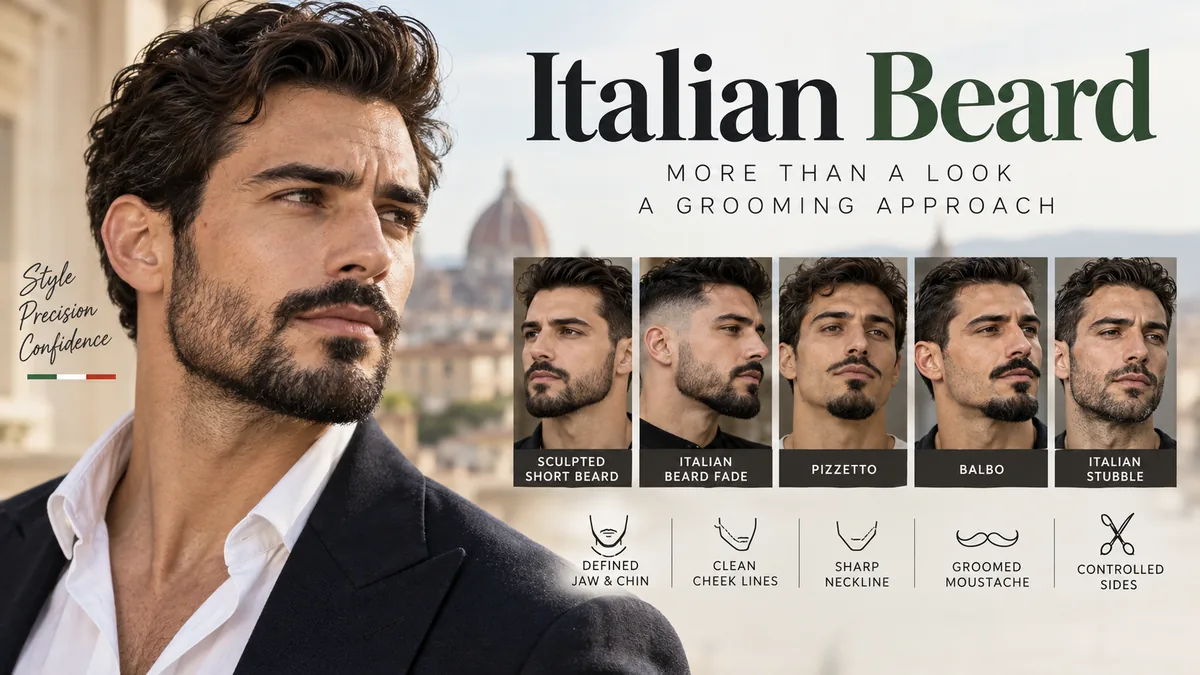
A beard can have plenty of growth and still look unfinished. With an italian beard, the difference comes from structure: controlled length, a deliberate cheek line, a clean neckline, and careful shaping around the jaw and chin.
The confusing part is that “Italian beard” does not describe one universally standardized facial-hair pattern. Modern barbers and grooming publications use the name for several related looks, from short sculpted beards and faded styles to the Balbo and Italian goatee. What connects them is precision rather than one mandatory length or moustache shape.
An italian beard is a deliberately groomed facial-hair style that emphasizes a defined jaw and chin, controlled sides, clean cheek and neckline boundaries, and a carefully shaped moustache. Modern versions often use a beard fade, while traditional Italian-inspired styles may feature a goatee, disconnected moustache, stubble, or fuller beard.
What Is an italian beard?
The italian beard is best understood as a grooming approach rather than a single fixed template.
Most interpretations share several characteristics:
- Defined cheek lines
- A clean, intentional neckline
- Controlled volume through the sides
- Greater visual weight around the chin or jaw
- Carefully groomed moustache
- Smooth transitions into the sideburns
- Natural-looking density without uncontrolled growth
Some versions have completely shaved cheeks and concentrate the hair around the moustache and chin. Others retain a full beard but taper the sides and sharpen its boundaries. Modern Italian beard fades can blend almost seamlessly into a faded haircut.
That variation explains why two photos labeled “Italian beard” may look noticeably different.
Current barbering sources also disagree on whether the moustache should connect to the beard. Some define the classic version through a connected moustache and chin beard, while Balbo-inspired and modern faded versions deliberately create separation.
What Is the Italian Beard Called?
There is no single official name covering every Italian-inspired beard.
The Italian word pizzetto is commonly associated with a goatee or chin-focused facial-hair style. Another important Italian-associated style is the Balbo beard, named after Italian aviator Italo Balbo. The Balbo normally combines a moustache with a separate beard around the chin and lower jaw.
You may also encounter names such as:
- Italian goatee
- Extended goatee
- Sculpted Italian beard
- Italian beard fade
- Italian stubble
- Short Italian beard
- Full Italian beard
Rather than relying on the name alone, show your barber a reference picture and discuss the cheek line, moustache connection, side length, chin length, and fade.
Popular italian beard Styles
The best style is not necessarily the one with the most facial hair. Italian-inspired grooming depends on proportion and deliberate shaping.
| Style | Main Characteristic | Good Match For | Maintenance |
|---|---|---|---|
| Sculpted short beard | Short, even growth with sharp boundaries | Everyday professional look | Medium |
| Italian beard fade | Short sideburns fading into fuller lower beard | Modern haircuts | High |
| Pizzetto | Hair concentrated around chin and mouth | Lighter cheek growth | Medium |
| Balbo | Moustache separated from lower beard | Strong chin growth | High |
| Designer stubble | Very short growth with defined edges | Low-length preference | Medium |
| Full Italian beard | Fuller jaw and chin with controlled sides | Dense facial hair | Medium |
| Extended goatee | Chin and moustache area extending toward jaw | Patchier upper cheeks | Medium |
1. Sculpted Short Italian Beard
This is one of the easiest interpretations to wear in everyday settings.
The beard remains relatively close to the face, but the cheek line and neckline are clearly defined. The sides are controlled so they do not overwhelm the jaw, while slightly more density can remain around the chin.
The result looks groomed without requiring a long beard.
It is particularly useful for someone trying the style for the first time because mistakes in overall length are easier to correct.
2. Italian Beard Fade
The italian beard fade brings modern barbering into the traditional polished aesthetic.
Instead of keeping the beard one length from sideburn to chin, the barber gradually changes the length. Hair is shortest near the sideburn and becomes fuller toward the lower cheek, jaw, and chin.
A good fade should look like a transition rather than several obvious horizontal bands.
This technique works particularly well when paired with:
- Skin fade haircut
- Low fade
- Taper fade
- Textured crop
- Slicked-back hair
- Short side-part haircut
GQ Italia describes the contemporary trend in similar terms: lighter sideburns, increasing length toward the moustache and chin, defined cheek and neck contours, and an emphasis on making the jaw visually clearer.
3. Italian Goatee or Pizzetto
The pizzetto concentrates attention around the mouth and chin rather than relying on dense cheek growth.
Depending on the variation, the moustache can connect with the chin beard or remain slightly separated.
This can be practical for men whose facial hair grows strongly around the chin and upper lip but sparsely on the cheeks. Instead of trying to disguise naturally lighter cheek coverage, the style makes the stronger growth areas intentional.
Keep the surrounding skin clean, however. Once stray cheek hairs begin appearing around a sharply shaped goatee, its geometry quickly becomes less distinct.
4. Balbo Beard
The Balbo is among the most recognizable Italian-associated facial-hair styles.
Its defining feature is separation. The moustache sits independently rather than connecting directly with the lower beard. Facial hair is concentrated around the chin and jaw, often accompanied by a small patch beneath the lower lip.
Because those negative spaces are part of the design, precision matters.
Allowing the gap between moustache and beard to fill with stubble can change the appearance significantly.
5. Italian Stubble
You do not need a long beard to create the Italian aesthetic.
Designer stubble keeps the facial hair extremely short while preserving clean cheek and neck boundaries. The visual effect comes from contrast between intentional stubble and freshly cleaned areas.
The advantage is less bulk.
The disadvantage is that short facial hair exposes inconsistencies. Stray hairs and poorly placed lines can be more noticeable because there is no length to soften them.
6. Full Italian Beard
Men with dense growth can keep considerably more facial hair while retaining Italian-style structure.
Instead of allowing equal volume everywhere, keep the sides controlled and let the chin and lower jaw carry more weight. A clean cheek boundary prevents the beard from appearing overgrown.
This is also where a quality beard brush becomes useful. Longer hairs do not always grow in the same direction, so brushing before trimming reveals the beard’s actual shape.
7. Extended Italian Goatee
An extended goatee moves beyond the chin and follows part of the lower jaw.
It provides more facial coverage than a traditional pizzetto without requiring a full cheek beard. For men with uneven cheek density, this can create a deliberate style from a growth pattern that might otherwise look patchy.
The key is symmetry. Both sides should extend approximately the same distance and follow the underlying face rather than creating arbitrary lines.
Which italian beard Suits Your Face Shape?
A beard cannot change your bone structure, but its proportions can change how the face is visually perceived.
This is one of the most useful principles in beard design.
Round Face
A round face generally benefits from less width through the cheeks and somewhat greater length around the chin.
Keep the sides controlled and avoid building a wide block of hair around the lower cheeks. A tapered beard or extended goatee can create stronger vertical emphasis.
Youssef Ouda’s barbering guide similarly recommends reducing cheek bulk while preserving more length below the chin for wider faces.
Square Face
A square face already has a prominent jaw.
You can reinforce that geometry with crisp edges, but excessive width may make the lower face appear heavier. Slightly rounded corners or a subtle taper can preserve the strong jaw while making the overall shape less rigid.
A short sculpted beard, Balbo, or controlled full beard can all work.
Oval Face
Oval faces offer considerable flexibility because their length and width are naturally balanced.
Short beard, stubble, Balbo, goatee, and faded variations can all work. The decision can therefore be based more heavily on beard density and preferred maintenance level.
Oblong or Long Face
Avoid adding excessive length below an already long face.
Instead, preserve some volume at the sides and keep the chin comparatively controlled. An extremely pointed or elongated beard can exaggerate vertical proportions.
Heart-Shaped Face
A heart-shaped face is typically wider through the upper face and narrower around the chin.
Adding controlled fullness around the chin and lower jaw can provide visual balance. A full Italian-inspired beard or rounded lower beard can work particularly well when growth density permits it.
Diamond Face
With a diamond-shaped face, the cheekbones are often visually prominent while the forehead and jaw are narrower.
Some controlled width around the jaw can balance those proportions. Avoid removing so much from the sides that the cheekbones appear even wider.
Quick Takeaway: Choose beard geometry before choosing beard length. Round faces often benefit from vertical emphasis, long faces from additional side presence, and narrower chins from controlled lower-face volume.
How to Grow an italian beard
Trying to sculpt the final style too early is one of the most common mistakes.
You first need enough growth to see where your beard is dense, where it changes direction, and whether the moustache naturally connects with the chin area.
1. Let the Beard Establish Its Growth Pattern
Allow your facial hair to grow before making major decisions about its final shape.
Some modern barbering guides recommend roughly three to four weeks before a significant Italian-style shaping, although the appropriate time depends heavily on individual growth rate and the style you want.
During this stage, resist repeatedly cutting into the cheek line.
You are gathering information about your natural coverage.
2. Assess Your Beard Density
Look closely at four areas:
- Moustache
- Chin
- Jaw
- Cheeks
Dense chin growth with sparse cheeks can suit a pizzetto, Balbo, or extended goatee.
Strong coverage everywhere gives you more freedom to choose a full beard or fade.
Uneven growth is not automatically a problem. The mistake is choosing a shape that depends on density you do not naturally have.
3. Decide Where You Want Visual Weight
This determines the personality of the beard.
More chin length creates vertical emphasis. More side volume creates width. Removing cheek growth focuses attention on the mouth and chin.
Choose deliberately rather than simply following your longest-growing hairs.
4. Establish the Overall Length
Trim bulk before attempting detailed outlines.
Start with a longer trimmer guard than you think you need. You can always remove more hair; restoring an accidentally short section takes weeks.
Work with the grain first and check both sides frequently.
5. Create the Cheek Line
The cheek line separates a sculpted beard from uncontrolled facial hair, but higher is often better than excessively low.
Preserve as much natural density as the intended style allows. Shaving deeply into the beard can make the cheeks look artificially thin.
For a full Italian beard, clean isolated hairs above the natural boundary and refine the line gradually.
For a goatee-based version, the cheeks may be shaved completely.
6. Define the Neckline
The neckline should support the jaw rather than sit directly on it.
A common barbering reference is to position the central boundary roughly one to two finger-widths above the Adam’s apple and create a shallow curve toward the area beneath the ears. Exact placement varies with anatomy and beard design.
Avoid pushing the line too high.
A neckline carved directly beneath the jaw can make the beard appear unnaturally small from the side.
7. Shape the Moustache
Now decide whether the moustache will connect.
For a connected Italian goatee, preserve the hair at the corners of the mouth.
For a Balbo or deliberately disconnected version, create a clean gap between the moustache and beard.
Trim hairs hanging over the upper lip, then comb the moustache before judging symmetry.
8. Blend the Sideburns
This is especially important for an Italian beard fade.
Use progressively different guard lengths rather than jumping abruptly from bare skin to a dense beard. If you are unsure about blending, this is the part most worth leaving to a barber.
How to Shape an italian beard at Home
Once a professional or careful initial trim establishes the geometry, maintaining it becomes easier.
You will generally need:
- Adjustable beard trimmer
- Detail trimmer
- Razor or foil shaver
- Beard comb
- Beard brush for longer growth
- Small grooming scissors
- Mirror with good lighting
Start with a clean, dry beard unless your trimmer manufacturer specifically recommends another method.
Step 1: Comb Everything Into Position
Never shape longer facial hair while it is tangled.
Comb or brush it into its normal direction first. This exposes genuinely long hairs rather than hairs temporarily sticking out.
Step 2: Reduce Bulk
Trim the largest areas first.
Keep more length wherever you want visual weight—usually the chin and lower jaw—and less through the upper sides if you want a tapered appearance.
Step 3: Check Symmetry From the Front
Do not stare at one side for too long.
Trim a small amount, switch sides, and compare. Human faces are naturally asymmetrical, so the goal is visual balance rather than mathematically identical measurements.
Step 4: Clean the Cheeks
Remove hair above your established cheek boundary.
Do not redraw the line every time you shave. Constantly lowering it is a common reason home-maintained beards become thinner over time.
Step 5: Clean the Neck
Remove hair beneath the established neckline while preserving the beard under the jaw.
Check your side profile afterward. The lower beard should create a coherent transition from chin to neck.
Step 6: Detail the Moustache and Lip
Use the corner of a trimmer or grooming scissors for control.
Remove hairs that sit on the lip, then check whether both moustache ends carry similar visual weight.
Step 7: Inspect the Beard in Normal Lighting
Bathroom lighting can hide problems.
Look at the beard from the front and both sides in ordinary daylight before making final adjustments. Often the best decision is to stop trimming rather than chase tiny differences until too much hair has been removed.
How to Create an Italian Beard Fade
A proper fade is a gradual change in length.
The exact guard numbers depend on the trimmer and desired beard length, so copying somebody else’s numerical settings is less reliable than understanding the principle.
Begin shorter at the sideburn.
Increase length progressively as you move toward the cheek and jaw. Keep the chin longest if the objective is to create a stronger lower-face profile.
Think in zones:
| Area | Relative Length |
|---|---|
| Upper sideburn | Shortest |
| Lower sideburn | Short |
| Upper cheek | Short to medium |
| Jaw | Medium |
| Chin | Medium to longest |
Use small upward movements when blending the boundary between zones.
If you can see obvious stripes where guard lengths change, the transition needs more blending.
A matching haircut fade can make the result appear continuous from temple to jaw, which is one reason this version has become prominent in contemporary Italian grooming coverage.
italian beard vs Balbo vs Goatee
These terms frequently overlap online, but they are not interchangeable.
| Feature | Modern italian beard | Balbo | Traditional Goatee |
|---|---|---|---|
| Cheek coverage | Varies | Limited | Usually little or none |
| Jaw coverage | Often yes | Yes | Usually limited |
| Moustache | Connected or disconnected | Disconnected | Optional/varies |
| Sideburn connection | May be blended | Usually disconnected | No |
| Chin emphasis | Strong | Strong | Strong |
| Beard fade | Common in modern versions | Not required | Uncommon |
| Maintenance | Medium-high | High | Medium |
The biggest distinction is that italian beard has become an umbrella-style grooming term, while Balbo describes a much more recognizable facial-hair configuration.
Likewise, not every goatee is Italian-inspired.
If communicating with a barber, the style name alone is therefore insufficient. Describe the exact geometry you want.
Can You Have an italian beard With a Patchy Beard?
Yes, provided the design works with the areas where your facial hair actually grows.
Patchiness becomes most obvious when you attempt to maintain a large uniform beard despite weak density in part of that area.
A shorter beard can reduce contrast between dense and sparse zones. Alternatively, removing weak cheek growth entirely and choosing a Balbo, pizzetto, or extended goatee makes the chin and moustache the deliberate focus.
Do not repeatedly trim a weak area shorter hoping it will become denser.
Trimming changes hair length, not the number of follicles producing visible hairs.
Your practical options are to:
- Change the shape
- Keep sparse sections shorter
- Preserve naturally dense regions
- Avoid unnaturally low cheek lines
- Choose a chin-focused style
- Let borderline areas grow before deciding they are unusable
Ouda’s barbering guidance also recommends adapting the shape to real density rather than designing around coverage that is not present.
How to Maintain an italian beard
The sharper your chosen style, the less forgiving it becomes as hair grows back.
That does not mean performing a complete beard trim every morning.
Separate maintenance into small jobs.
Daily Care
Comb or brush the beard into position and check the moustache around the lip.
If your version depends on completely clean cheeks or a distinct Balbo-style separation, those exposed areas may need frequent shaving.
For longer facial hair, a small amount of beard oil can reduce dryness and make the hair easier to control.
Every Few Days
Clean obvious stray hairs around established boundaries.
Short stubble and sharply disconnected styles generally need more frequent attention because a few millimeters of regrowth can blur the intended negative space.
Weekly Maintenance
Check:
- Overall length
- Cheek symmetry
- Neckline
- Sideburn blend
- Moustache balance
- Stray hairs around the chin
Do not automatically shorten every area.
Often you only need to restore the outline.
Professional Reshaping
How often you need a barber depends on growth rate and complexity.
A highly faded or precisely sculpted beard loses its transitions faster than a natural full beard. One professional barbering guide suggests two to three weeks as a practical starting point for maintaining precise geometry, with faster-growing or sharper styles needing earlier attention.
Beard Oil, Balm, and Other Grooming Products
Products support a beard style; they do not create the underlying geometry.
Beard Oil
Beard oil is primarily useful for conditioning facial hair and the skin beneath it.
A few drops may be enough for a short beard. Using too much can leave facial hair looking greasy rather than naturally groomed.
Beard Balm
Balm provides more control than oil and can help longer hairs remain in position.
It is useful when the chin area has enough length to develop flyaways.
Beard Wash
Facial skin and beard hair can become dry if repeatedly washed with harsh cleansers.
Use a beard-appropriate or mild cleanser as needed, particularly after sweating or exposure to dirt and styling products.
Beard Brush and Comb
These are functional tools, not decorative accessories.
A comb helps separate hair and guide trimming. A brush can distribute natural oils and reveal the actual silhouette of a medium or longer beard.
Common italian beard Mistakes
Small shaping errors have a disproportionate effect on a precision beard.
Cutting the Neckline Too High
This is probably the most damaging home-trimming mistake.
From the front it may initially look clean. From the side, however, an overly high neckline can expose the underside of the jaw and make the beard appear pasted onto the face.
Keep enough hair beneath the jaw to support the shape.
Shaving the Cheek Line Too Low
Higher natural cheek coverage usually makes a beard look fuller.
Clean the boundary rather than automatically removing centimeters of usable facial hair.
Using One Guard Everywhere
Uniform length can work for some short beards, but it removes the graduated structure that defines many contemporary Italian looks.
Use controlled differences in length when you want stronger facial shaping.
Copying a Beard Without Considering Face Shape
A beard that looks excellent on a long, narrow face can exaggerate a round face in the wrong direction—and vice versa.
Copy the design principles, not simply the measurements.
Trying to Fix Every Asymmetry
Faces are not perfectly symmetrical.
Repeatedly trimming the fuller side to match every tiny difference can eventually leave both sides too short. Judge the beard from normal conversational distance.
Ignoring the Moustache
A carefully sculpted beard paired with an uncontrolled moustache looks incomplete.
Comb it, clean the lip line, and decide deliberately whether it connects to the beard.
Overusing Styling Products
More oil or balm does not produce a more polished beard.
The foundation is still the cut: shape first, product second.
Quick Takeaway: Preserve your natural density, establish the neckline once, maintain rather than constantly redesign your cheek line, and use graduated lengths only where they improve your facial proportions.
How to Ask Your Barber for an italian beard
Do not simply say, “Give me an Italian beard.”
Because the term covers several interpretations, you and the barber may be imagining completely different styles.
Bring a reference photo and discuss five details:
- Sideburns: natural, tapered, or skin faded?
- Cheeks: full, naturally defined, lowered, or completely shaved?
- Chin: same length as the sides or noticeably longer?
- Moustache: connected or deliberately disconnected?
- Neckline: natural-looking or extremely sharp?
You can describe a contemporary version like this:
“Keep the sides controlled and gradually blend them into more length around the jaw and chin. Keep the cheek line sharp but close to my natural growth, define the neckline without pushing it too high, and blend the sideburns into my haircut.”
If you want a Balbo, specifically mention the disconnected moustache.
That one detail changes the style substantially.
Does an italian beard Make the Jawline Look Sharper?
It can make the jaw appear more defined, but it cannot alter your actual jawbone.
The effect is visual.
Removing excess width from the cheeks, creating a clean lower outline, and positioning additional density around the chin and jaw changes the silhouette of the lower face. This is why the same beard length can produce very different results depending on how it is shaped.
A sharply defined beard will not compensate for every facial proportion, however. If you carve the neckline too high or make the sides too narrow, the attempted jaw-enhancing effect can work against you.
Good beard design follows the face rather than trying to draw a completely new one over it.
Is the italian beard High Maintenance?
It depends on the variation.
A naturally outlined full beard is relatively forgiving. A beard fade, Balbo, or extremely short sculpted style requires more precision.
Generally, maintenance increases when the design contains:
- Skin fades
- Completely shaved cheek areas
- Disconnected moustache sections
- Very sharp cheek lines
- Short stubble next to bare skin
- Significant differences between side and chin lengths
If you prefer lower maintenance, choose a short full beard with natural cheek coverage and a clean neckline.
If you enjoy frequent grooming, a faded or disconnected style gives you more visible structure.
The Key to Getting the italian beard Right
The best italian beard is not necessarily the darkest, longest, or most dramatic one. It is the version that makes your natural beard density and facial proportions look intentional.
Start by letting enough facial hair grow to understand your coverage. Choose the style according to your face shape and strongest growth areas. Establish a conservative cheek line and properly positioned neckline, then decide how much contrast you want between the sideburns, jaw, chin, and moustache.
For a modern appearance, gradually tapered sides and extra structure around the lower face work well. For something more traditional and distinctive, explore the Balbo or pizzetto. If your cheeks grow unevenly, a chin-focused version can turn that limitation into part of the design.
Most importantly, do not chase an arbitrary definition of what an Italian beard “must” look like. Current grooming sources themselves use the term for multiple connected and disconnected styles.
Treat it as a principle of precision, proportion, controlled texture, and deliberate grooming. Once those elements are right, the style looks intentional from every angle.