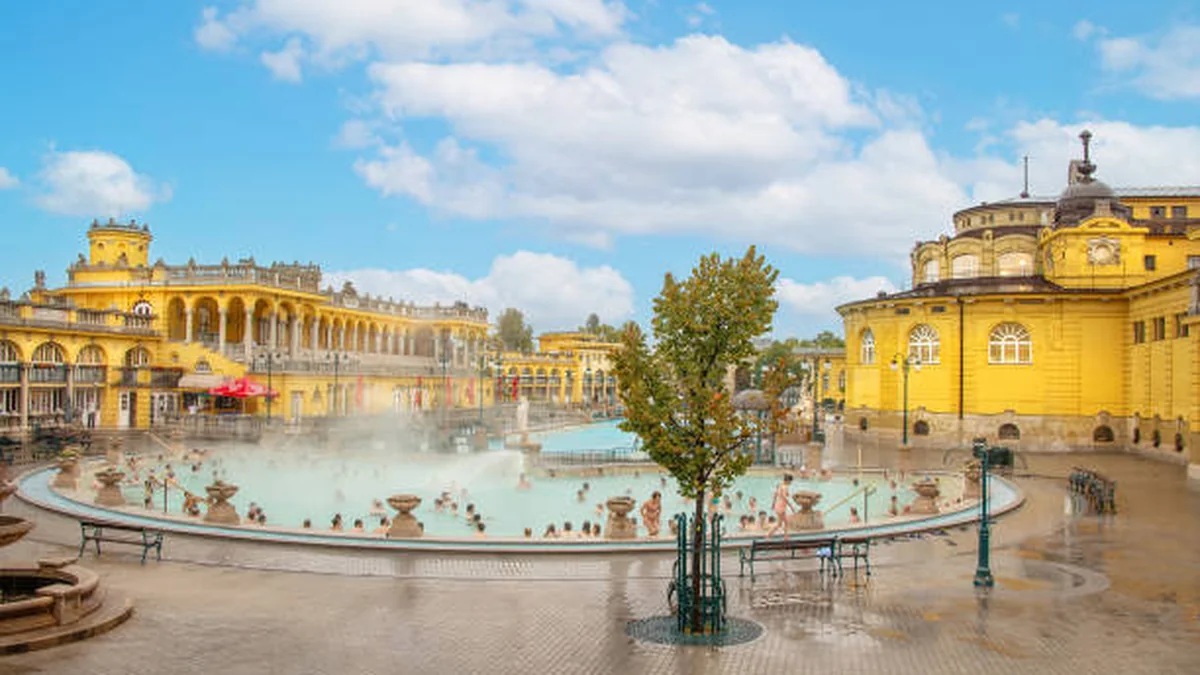
Budapest thermal baths are the reason I stood in Széchenyi’s outdoor pool in January, snow falling on my shoulders while my legs soaked in 38°C water, and understood why Hungarians have been doing this for two thousand years. It’s not really about the water. It’s about slowing down in a city that makes it easy to.
Budapest has around 100 thermal springs feeding roughly 50 bathhouses, and the practice dates back to Roman-era Aquincum. Today, Széchenyi, Rudas, and Lukács are the main Budapest thermal baths open to visitors, offering mineral-rich pools, saunas, and historic Ottoman or Austro-Hungarian architecture — though as of 2026, Gellért and Király are both closed for renovation, which changes where first-timers should go.
What Are Budapest’s Thermal Baths, Exactly?
Budapest earned the nickname “City of Spas” back in 1934, and it wasn’t marketing spin. The city sits on a geological hotspot where naturally heated groundwater rises close to the surface, and locals have been building bathing culture around it since before Budapest was even Budapest.
A “thermal bath” here isn’t a spa in the resort-hotel sense. It’s usually a large public bathing complex with several indoor pools at different temperatures, at least one outdoor pool, saunas, steam rooms, and often a cold plunge. Some are grand, Austro-Hungarian-era palaces. Others are compact, centuries-old Ottoman hammams with octagonal pools and domed ceilings pierced with colored glass.
Locals don’t treat this as a tourist novelty. Retirees play chess waist-deep in hot water. Regulars have routines they swear by. It’s closer to a neighborhood ritual than an attraction — which is part of why it’s worth doing properly rather than rushing through.
The History of Budapest’s Thermal Baths (Romans, Ottomans, and a Yellow Palace)
The Celtic Eravisci tribe called this land “Ak-ink” — abundant water — before the Romans arrived and built Thermae Maiores, the Great Bath, near what’s now Óbuda. You can still see the ruins.
The next major wave came under Ottoman rule in the 16th and 17th centuries, when Turkish builders introduced the hammam style still visible at Rudas and Veli Bej: octagonal pools, high domes, shafts of light through glass inlays. Some of these baths have run continuously for over 450 years.
The grand, palatial baths most visitors picture — Széchenyi’s yellow neo-Baroque facade, Gellért’s Art Nouveau tilework — came later, during the Austro-Hungarian period of the early 1900s. Engineer Vilmos Zsigmondy spent a decade drilling before striking thermal water on the Pest side in 1878, disproving the assumption that only the Buda side had springs. Architect Győző Czigler designed Széchenyi, which opened in 1913 and remains the largest bathing complex in Europe.
The Best Thermal Baths in Budapest, Compared
Széchenyi Baths
The one everyone pictures. Fifteen indoor pools, three outdoor pools, and a bright yellow neo-Baroque building set inside City Park. It’s the biggest and busiest — genuinely one of the largest thermal complexes in Europe, drawing over a million visitors a year. Go early (it opens as early as 6 a.m.) or you’ll be sharing the water with a lot of company by mid-morning.
Best for: first-timers, photography, the classic “Budapest bath” experience.
Rudas Baths
A 16th-century Ottoman octagonal pool under a domed ceiling, plus a modern wellness wing with a rooftop hot tub overlooking the Danube. It’s the oldest continuously operating bath in the city. Historically single-sex on certain weekdays with mixed weekends — check the current schedule before you go, as hours shift seasonally.
Best for: history, river views, a quieter and more contemplative atmosphere than Széchenyi.
Lukács Baths
Attached to an actual medical rehabilitation facility, Lukács draws a strong local crowd and has a reputation among Hungarians as the most therapeutically effective water in the city. It costs noticeably less than Széchenyi and feels far less touristy.
Best for: budget-conscious visitors, a more authentic local feel.
Veli Bej Baths
A smaller, quieter 16th-century Ottoman hammam without an outdoor section. Recently renovated, it’s the pick for people who want the Turkish-bath atmosphere without Rudas’s crowds.
Best for: a calmer, more intimate hammam experience.
Palatinus Strand Baths
An outdoor “strand” complex on Margaret Island — wave pools, water slides, and a genuinely family-friendly layout. Seasonal (roughly May to October).
Best for: families and anyone traveling with children under 14, who can’t enter the thermal-only baths (more on that below).
Quick Comparison
| Bath | Style | Vibe | Outdoor Pool | Good For |
|---|---|---|---|---|
| Széchenyi | Austro-Hungarian palace | Busy, social | Yes, year-round | First-timers |
| Rudas | Ottoman + modern wellness | Contemplative | Yes, rooftop | River views, history |
| Lukács | Early 20th-century, medical | Local, low-key | Yes | Budget, authenticity |
| Veli Bej | Ottoman hammam | Quiet | No | Intimate hammam feel |
| Palatinus | Outdoor strand | Lively, family | Yes, seasonal | Families with kids |
Important 2026 Update on Budapest Thermal Baths: Gellért and Király Are Closed
Here’s something a lot of older guides still get wrong: Gellért Baths has been closed since October 1, 2025, for major renovation, with reopening projected for 2028. If you came here planning to see the famous blue-tiled Art Nouveau pools, you’ll need to adjust — Gellért is off the table for the next couple of years.
Király Bath is also currently under restoration and unavailable to visitors.
Practically, this means visitor traffic has concentrated at Széchenyi, Rudas, and Lukács. Advance booking matters more than it used to, especially in summer, when Széchenyi routinely sells out online. If Gellért was your main draw, Rudas is the closest substitute for atmosphere, and Széchenyi is the closest substitute for scale.
Budapest Thermal Baths Prices, Tickets, and Booking
Prices went up roughly 5% across most baths from January 7, 2026, and they vary by day of the week, ticket type, and whether you want a locker or a private cabin.
- Széchenyi: weekday tickets start around 13,200 HUF, weekend around 14,800 HUF, with cabin upgrades adding roughly 1,000 HUF
- Rudas: weekday all-zone access runs around 12,000 HUF
- Lukács: the most affordable of the major baths, starting around 7,000 HUF
- Night bathing (where offered, like Rudas’s Friday/Saturday sessions) runs roughly €30–35
Book online in advance if you can — same-day queues at the ticket windows can be long, especially in summer. Every visitor gets an RFID wristband at entry; it’s your locker key and your on-site payment method rolled into one, so don’t lose it (replacements aren’t cheap). Cabins cost a bit more than lockers but give you a private space to change, which is worth it if you’re not comfortable changing in a communal room.
Budapest Thermal Bath Etiquette Nobody Tells You in Advance
Age restrictions are stricter than they used to be. As of a nationwide regulation change on August 1, 2025, children under 14 are not permitted in Budapest’s thermal baths at all — a tightening of what was previously a more loosely enforced rule. If you’re traveling with younger kids, head to Palatinus Strand or one of the city’s lidos instead; they have dedicated children’s pools.
Nudity isn’t permitted in public areas at any bath. Bring a swimsuit — this isn’t Central Europe’s naked-sauna culture. Some baths still separate men and women on certain traditional days and hand out simple loincloths or aprons, but most visitors, local and tourist alike, wear regular swimwear throughout.
A swim cap is required in the swimming (lap) pools, but not in the thermal soaking pools. Bring one if you plan to do laps.
Quiet is expected indoors. The indoor thermal halls have a hushed, almost reverent atmosphere — save loud conversation for the outdoor pools or the on-site bar.
Shower before you get in. It’s standard practice and often genuinely required.
What to Pack (and What to Leave at the Hotel)
Bring: a swimsuit, a swim cap if you’re planning laps, flip-flops (the tiled floors get slippery and hot), a lightweight quick-dry towel (rental has largely disappeared as a standard inclusion), and an empty water bottle if you want to try the mineral-rich drinking fountains at Széchenyi, Rudas, or Lukács.
Leave behind: a full-size towel (bulky and slow to dry), valuables you’re not comfortable locking in a wristband-controlled locker, and, per the age policy above, children under 14.
Are the Health Benefits Real?
Honestly — it’s complicated, and any guide that promises miracle cures is overselling it. The waters here are genuinely mineral-rich, typically containing calcium, magnesium, sulphates, sodium, and bicarbonates, and doctors do use balneotherapy (bathing-based treatment) for conditions like arthritis and muscle pain. Lukács in particular sits beside an actual medical rehabilitation clinic, and people travel from elsewhere in Hungary specifically for treatment there.
But the clinical evidence for long-term healing effects is thin — science hasn’t conclusively proven that soaking cures anything. What’s not in dispute is the short-term relief: warm mineral water genuinely eases sore muscles, and the ritual of alternating hot pools, cold plunges, and rest is a legitimately good way to de-stress, even if you leave the arthritis debate to the doctors.
How to Have a Genuinely Good Day at the Baths
Go early. Crowds build steadily from mid-morning and peak by early afternoon; arriving at opening gets you a noticeably calmer experience, especially at Széchenyi.
Pace yourself. The common local guidance is to stay in a hot pool for around 20 minutes, then rest on a lounger or take a quick cool shower before going back in — not to marathon a single pool for hours.
Skip the on-site couples massage if you’re after something indulgent. It’s serviceable but brisk, without the ambiance of a dedicated spa — fine for muscle relief, not a romantic splurge.
If you want the nightlife side of bath culture, Széchenyi’s Saturday-night “Sparty” turns the outdoor pools into a lit-up, music-driven party; it’s genuinely fun once, even if you’re not usually a club person.
Don’t rush all three major baths into one trip. Pick one, maybe two, and actually spend a few hours there — that’s the entire point of the ritual.
Explore more destinations like this in our full travel guide collection.
Frequently Asked Questions
How many thermal baths are there in Budapest? Budapest has around 100 thermal springs feeding roughly 50 bathhouses and spas citywide, though most visitors focus on the handful of major public baths — currently Széchenyi, Rudas, Lukács, Veli Bej, Dandár, and the seasonal Palatinus, since Gellért and Király are both closed for renovation.
Is Gellért Baths open in 2026? No. Gellért closed on October 1, 2025, for major renovation work and isn’t expected to reopen until 2028. Rudas is the closest substitute for historic atmosphere in the meantime.
Which Budapest thermal bath is best for first-timers? Széchenyi, for scale, photogenic architecture, and the classic outdoor-soaking-in-winter experience. Rudas is a strong second choice if you want something quieter with river views.
Can children visit Budapest’s thermal baths? Not the thermal baths themselves — a nationwide rule tightened in August 2025 bars anyone under 14 from entering. Families should head to Palatinus Strand Baths or a city lido instead, both of which have dedicated children’s pools.
Do I need to bring my own swimsuit and towel? Yes. Nudity isn’t allowed in public bath areas, and towel rental is no longer standard at most baths — bring your own lightweight, quick-dry towel.
How much do Budapest thermal baths cost in 2026? Roughly 7,000 HUF at the more affordable Lukács up to about 14,800 HUF for a weekend ticket at Széchenyi, with cabin upgrades and massage packages costing extra. Prices rose about 5% from January 2026.
Do the thermal baths smell bad? Some mineral waters have a mild sulphur note, but it’s far subtler than natural hot springs in places like Iceland — most visitors barely notice it after the first few minutes.
Is it better to book tickets online in advance? Yes, especially in summer. Széchenyi in particular sells out online on busy days, and walk-up queues can be long.
Final Thoughts
Budapest’s thermal baths aren’t a box to check off — they’re a genuinely different pace of travel day, built around water that’s been drawing people to this exact spot for two thousand years. Pick Széchenyi if you want the postcard experience, Rudas if you want something quieter with history attached, and just remember that Gellért and Király are sitting this era out. Book ahead, bring a swimsuit, and give yourself more time there than feels necessary — that’s the whole point.
FAQ Section
How many thermal baths are there in Budapest?
~100 springs feed roughly 50 bathhouses; most visitors focus on Széchenyi, Rudas, Lukács, Veli Bej, Dandár, and seasonal Palatinus, since Gellért and Király are closed for renovation.
Is Gellért Baths open in 2026?
No — closed since October 1, 2025, reopening projected 2028; Rudas is the closest substitute.
Which bath is best for first-timers?
Széchenyi for scale and atmosphere; Rudas for a quieter, river-view alternative.
Can children visit?
No — nationwide rule since August 2025 bars under-14s; use Palatinus Strand or a city lido instead.
Do I need my own swimsuit and towel?
Yes — nudity isn’t allowed, and towel rental is no longer standard.
How much do tickets cost in 2026?
~7,000–14,800 HUF depending on bath and day, plus ~5% increase from January 2026.
Do the baths smell bad?
Mildly sulphuric at some baths, but subtler than most natural hot springs.
Should I book online?
Yes, especially in summer when Széchenyi sells out.