Cells constantly exchange materials with their surroundings. Oxygen needs to enter, carbon dioxide and other wastes need to leave, water must remain balanced, and ions and nutrients must move where they are needed. Yet not every movement across a cell membrane requires the cell to spend energy.
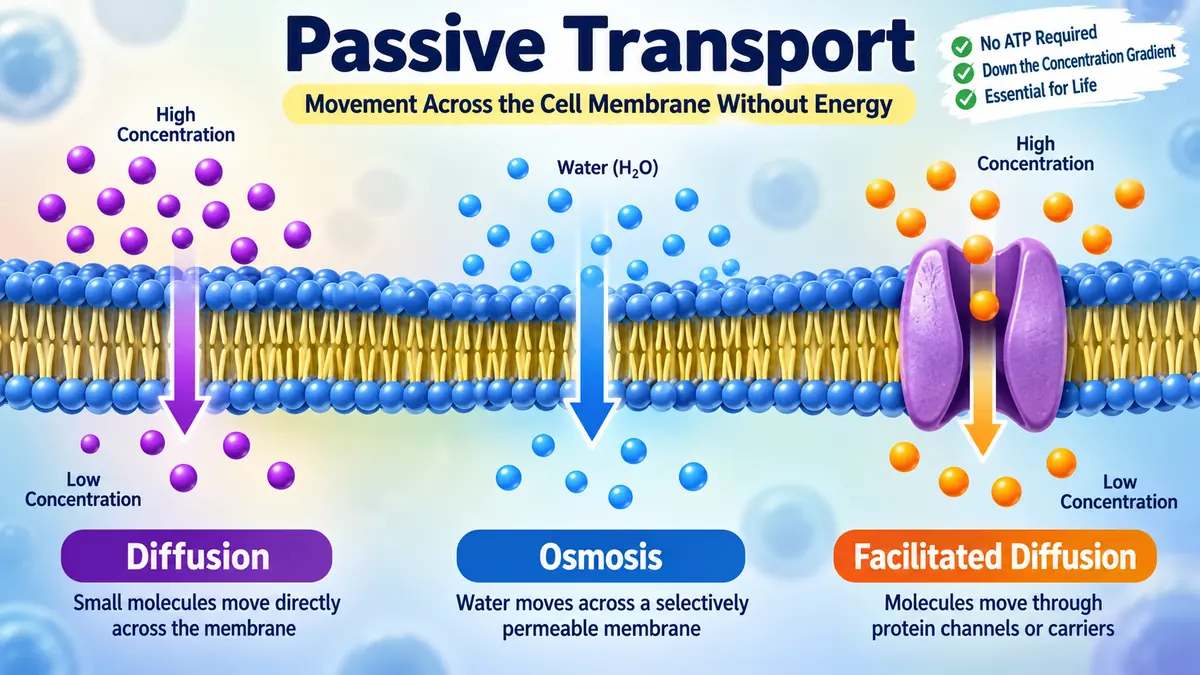
Passive transport is the movement of substances across a cell membrane without the cell directly using metabolic energy such as ATP. It normally moves substances down a concentration or electrochemical gradient, from a region of higher potential to lower potential, through simple diffusion, osmosis, or protein-assisted facilitated diffusion.
Understanding passive transport explains much more than how molecules cross a membrane. It helps make sense of gas exchange, water balance, nutrient movement, nerve-cell ion behavior, and the way cells maintain a stable internal environment.
What Is Passive Transport?
Passive transport is a form of membrane transport in which molecules or ions move without direct energy expenditure by the cell.
The driving force usually comes from an existing concentration gradient. If more molecules of a substance are present on one side of a membrane than the other, random molecular motion tends to produce a net movement toward the side with the lower concentration.
For charged particles such as ions, concentration is not the only factor. Electrical forces also matter. Together, the concentration difference and electrical potential form an electrochemical gradient, which determines whether passive movement of an ion is energetically favorable.
This leads to a useful distinction:
| Feature | Passive transport |
|---|---|
| Cellular ATP required directly? | No |
| Typical direction | Down a concentration or electrochemical gradient |
| Membrane proteins always needed? | No |
| Can transport proteins be involved? | Yes |
| Major mechanisms | Simple diffusion, facilitated diffusion, osmosis |
| Typical outcome | Movement toward equilibrium |
The word passive does not mean that nothing is happening. Molecules are continually moving because of their thermal energy. What makes the process passive is that the cell does not need to couple that movement directly to an additional source of metabolic energy.
What Is a Concentration Gradient?
A concentration gradient exists whenever the amount of a substance differs between two regions.
Imagine 100 oxygen molecules on one side of a membrane and 20 on the other. Individual oxygen molecules move randomly in both directions. However, because many more molecules start on the crowded side, the net movement is toward the less concentrated side.
This movement continues until the distribution becomes more balanced.
At equilibrium, molecular movement does not stop. Molecules still cross back and forth, but there is no longer a net movement in one direction.
That distinction between molecular movement and net movement is one of the most commonly misunderstood parts of diffusion.
Types of Passive Transport
The three major forms usually taught in cell biology are:
- Simple diffusion
- Facilitated diffusion
- Osmosis
Some educational classifications also include filtration, particularly in physiology, where pressure drives water and small solutes across a membrane or capillary wall. Biology Online, for example, describes simple diffusion, facilitated diffusion, filtration, and osmosis as major passive mechanisms.
For cellular membrane biology, however, diffusion, facilitated diffusion, and osmosis are the core mechanisms students most often need to understand.
Simple Diffusion in Passive Transport
Simple diffusion occurs when a substance moves directly through the phospholipid bilayer without requiring a channel or carrier protein.
The plasma membrane consists largely of a phospholipid bilayer. Its interior is hydrophobic, which means it favors some substances while strongly resisting others.
Small, nonpolar molecules pass through relatively easily.
Common examples include:
- Oxygen (O₂)
- Carbon dioxide (CO₂)
- Some small lipid-soluble molecules
Khan Academy notes that small nonpolar molecules such as oxygen and carbon dioxide can diffuse directly through the membrane because of the membrane’s selective permeability.
How Simple Diffusion Works
Suppose oxygen concentration is higher outside a cell than inside it.
Oxygen molecules collide randomly with the membrane. Because oxygen is small and nonpolar, some molecules pass through the hydrophobic interior of the phospholipid bilayer.
As long as the concentration remains higher outside the cell, more oxygen molecules will move inward than outward.
The result is net diffusion into the cell.
No ATP-powered pump is needed.
What Determines the Rate of Diffusion?
Diffusion does not occur at one fixed speed. Several variables influence how rapidly molecules spread.
Concentration Gradient
A steeper concentration gradient generally produces faster net diffusion.
If the concentration difference between two regions is large, the imbalance in molecular movement is greater.
Temperature
Higher temperatures generally increase molecular motion, which can increase diffusion rates.
Molecular Size
Smaller molecules usually diffuse faster than larger ones under comparable conditions.
Surface Area
A larger available membrane surface can permit more molecules to cross at the same time.
Diffusion Distance
Movement across a thin barrier is faster than across a thick one.
Membrane Permeability
The chemistry of the molecule and membrane determines how easily a substance can cross.
The hydrophobic core of the cell membrane therefore plays a central role in determining which substances can undergo simple diffusion.
Facilitated Diffusion in Passive Transport
Many biologically important substances cannot cross the phospholipid bilayer efficiently on their own.
Ions are charged. Many sugars and other molecules are polar. The membrane’s hydrophobic core forms a major barrier to these substances.
Cells solve this problem through facilitated diffusion.
Facilitated diffusion is passive movement down a concentration or electrochemical gradient with the assistance of a membrane protein. It still does not require the transporter to use ATP simply to move the substance downhill.
Two major types of transport proteins are involved:
- Channel proteins
- Carrier proteins
Channel Proteins
Channel proteins form hydrophilic pathways through the membrane.
These pathways allow particular ions or molecules to cross the membrane without entering the hydrophobic lipid interior.
Ion channels may transport substances such as:
- Sodium ions (Na⁺)
- Potassium ions (K⁺)
- Calcium ions (Ca²⁺)
- Chloride ions (Cl⁻)
Some channels remain open, while others are gated and open only in response to particular signals.
A crucial point is that a channel does not automatically mean active transport.
If an ion travels through a channel down its electrochemical gradient, the process is passive.
Carrier Proteins
Carrier proteins work differently.
A carrier binds a particular molecule on one side of the membrane. The protein then changes shape, exposing the binding site to the opposite side and releasing the molecule.
The molecule is still moving in an energetically favorable direction.
Glucose transporters provide a classic example of protein-mediated transport in cells.
Carrier proteins are usually selective because their binding sites recognize particular molecular structures.
Does Facilitated Diffusion Require Energy?
This is a common exam question.
Facilitated diffusion does not require direct ATP expenditure.
The confusion comes from the fact that a protein participates in the process. Proteins are involved in both passive and active transport, so the presence of a transport protein alone does not tell you whether the process requires energy.
The correct question is:
Is the substance moving down or against its electrochemical gradient, and is an external energy source being coupled to that movement?
Moving downhill through a channel or passive carrier is facilitated diffusion.
Moving uphill requires an active transport mechanism.
Osmosis: Passive Transport of Water
Osmosis is the net movement of water across a selectively permeable membrane in response to differences in solute concentration and water potential.
Water moves in ways that tend to reduce differences between the solutions on opposite sides of a membrane.
In introductory biology, osmosis is often described as water moving from an area with relatively more free water and lower solute concentration toward an area with relatively less free water and higher solute concentration.
Because cell membranes are selectively permeable, water balance can dramatically affect cell volume.
Hypotonic Solutions
A hypotonic solution has a lower effective concentration of nonpenetrating solutes than the cell.
Water tends to enter the cell.
Animal cells can swell and may eventually lyse if excessive water enters.
Plant cells respond differently because their rigid cell walls resist expansion. Water entering a plant cell produces turgor pressure, which helps support plant tissues.
Hypertonic Solutions
A hypertonic solution contains a higher effective concentration of nonpenetrating solutes than the cell.
Water tends to leave the cell.
Animal cells shrink as they lose water.
Plant cells may undergo plasmolysis, in which the plasma membrane pulls away from the cell wall as the cytoplasm loses water.
Isotonic Solutions
In an isotonic solution, effective solute concentrations are balanced so there is no sustained net water movement that changes cell volume.
Water still crosses the membrane in both directions.
Again, equilibrium does not mean molecules have stopped moving.
Aquaporins and Water Movement
Although some water can cross lipid membranes directly, many cells contain specialized water-channel proteins called aquaporins that allow rapid water movement.
Aquaporins are an excellent reminder that protein-assisted movement can still be passive when the substance moves down its appropriate gradient.
Passive Transport Through the Cell Membrane
To understand why cells need several types of passive transport, it helps to look at the structure of the plasma membrane.
The membrane follows the fluid mosaic model and contains:
- Phospholipids
- Membrane proteins
- Cholesterol in animal-cell membranes
- Carbohydrate-containing molecules on the outer surface
Each phospholipid has a hydrophilic head and hydrophobic fatty-acid tails. The molecules arrange themselves into a bilayer with the hydrophobic tails facing inward.
That hydrophobic interior creates selective permeability.
Small nonpolar molecules can usually cross more readily than charged or strongly polar molecules. Larger substances may also have difficulty moving directly through the membrane.
The membrane therefore acts less like an open doorway and more like a controlled boundary.
Which Substances Can Move Passively?
The transport route depends heavily on molecular properties.
| Substance | Likely passive route |
|---|---|
| Oxygen | Simple diffusion |
| Carbon dioxide | Simple diffusion |
| Water | Osmosis, often through aquaporins |
| Na⁺ | Ion channel when moving down its electrochemical gradient |
| K⁺ | Ion channel when moving down its electrochemical gradient |
| Cl⁻ | Ion channel when moving down its electrochemical gradient |
| Glucose | Carrier-mediated facilitated diffusion in many contexts |
| Large proteins | Generally cannot cross by simple passive transport |
This selectivity is essential for homeostasis, because cells must control their internal concentrations rather than simply becoming chemically identical to the surrounding fluid.
Passive Transport vs Active Transport
Passive transport becomes much easier to understand when compared with active transport.
The central difference involves energy and direction relative to a gradient.
| Passive transport | Active transport |
|---|---|
| Does not directly require cellular energy input | Requires energy coupling |
| Moves substances down an electrochemical gradient | Can move substances against a gradient |
| Includes simple diffusion | Includes primary and secondary active transport |
| Can use channels or passive carriers | Uses pumps, carriers, or coupled transporters |
| Tends toward equilibrium | Can create and maintain disequilibrium |
Active transport is necessary because living cells cannot survive at equilibrium with every aspect of their surroundings.
Cells maintain unequal ion concentrations across their membranes. These differences provide stored potential energy and are essential for functions including electrical signaling and secondary transport.
The Sodium-Potassium Pump Is Not Passive Transport
The sodium-potassium pump, or Na⁺/K⁺-ATPase, is a classic example of active transport.
It uses ATP to help maintain unequal distributions of sodium and potassium across the plasma membrane.
By contrast, when potassium later moves through an open potassium channel down its electrochemical gradient, that particular movement is passive.
The distinction matters:
Creating a gradient can require energy even though later movement down that gradient does not.
This explains why saying passive transport “uses no energy whatsoever” can be misleading.
The immediate passive transport event does not require direct metabolic energy input, but living cells often spend substantial energy establishing the gradients that make passive movement possible.
Primary vs Secondary Active Transport
In primary active transport, a transporter directly couples movement to an energy source such as ATP hydrolysis.
In secondary active transport, the transporter uses energy stored in another ion’s electrochemical gradient.
Secondary transport may involve:
- Symport, where substances move in the same direction
- Antiport, where substances move in opposite directions
These mechanisms differ fundamentally from passive diffusion because at least one transported substance is being driven in a direction that would not occur spontaneously on its own.
What Is an Electrochemical Gradient?
For uncharged substances, concentration differences usually dominate passive movement.
For ions, the situation is more complex.
An ion experiences two forces:
- A chemical gradient produced by differences in concentration
- An electrical gradient produced by differences in charge across the membrane
Together, these form the electrochemical gradient.
For example, suppose a positively charged ion is more concentrated outside a cell. Its chemical gradient may push it inward.
If the inside of the cell is also electrically negative relative to the outside, electrical attraction can favor inward movement too.
Both forces then point in the same direction.
In another situation, chemical and electrical forces may oppose each other.
This is why describing ion movement only as “high concentration to low concentration” is incomplete. For ions, membrane potential must also be considered.
Examples of Passive Transport in Living Organisms
Passive transport occurs continuously throughout living systems.
Oxygen Entering Cells
Cells consume oxygen during aerobic cellular respiration.
When oxygen concentration is lower inside a cell than in the surrounding environment, oxygen can diffuse across the cell membrane.
The molecule is small and nonpolar, so it can cross the phospholipid bilayer without a transporter.
Carbon Dioxide Leaving Cells
Cellular metabolism produces carbon dioxide.
When CO₂ concentration becomes higher inside a cell, the gas diffuses outward across the plasma membrane.
In tissues, carbon dioxide eventually enters the blood for transport toward the lungs.
Gas Exchange in the Lungs
Oxygen moves from air in the alveoli toward blood where its partial pressure is lower, while carbon dioxide moves in the opposite direction.
This gas exchange depends heavily on diffusion across extremely thin respiratory surfaces.
A large surface area and short diffusion distance make the process efficient.
Glucose Moving Through Transport Proteins
Glucose is polar and cannot efficiently cross the lipid bilayer by simple diffusion.
Many cells use specific transporter proteins that allow glucose to undergo facilitated diffusion when the appropriate concentration gradient exists.
This is a good example of why “passive” does not mean “without proteins.”
Water Moving Into and Out of Cells
Changes in extracellular solute concentration alter osmotic water movement.
Red blood cells, plant cells, kidney tissues, and many other biological systems depend on carefully regulated water balance.
Ion Movement Through Channels
Neurons and muscle cells contain numerous ion channels.
When ions move through an open channel down their electrochemical gradient, that movement is passive even though the resulting changes may contribute to complex events such as electrical signaling.
Why Passive Transport Is Important
Passive transport is fundamental to cell survival because it allows useful molecular exchange without requiring ATP for every individual transport event.
Its functions include:
- Supplying cells with oxygen
- Removing metabolic gases and some wastes
- Maintaining water balance
- Allowing controlled ion movement
- Supporting nutrient transport
- Contributing to membrane electrical behavior
- Helping cells respond to their environment
- Supporting homeostasis
If every molecule crossing the cell membrane required direct ATP hydrolysis, membrane transport would impose a much larger metabolic burden.
Instead, cells use a combination of gradients, selective membranes, channels, carriers, and active pumps.
How Passive Transport Reaches Equilibrium
One of the biggest misconceptions about diffusion is that molecules “want” to move from high concentration to low concentration.
Molecules do not make directional decisions.
They move randomly.
Suppose side A contains 1,000 molecules and side B contains 100. Molecules may cross both ways, but because side A contains many more molecules, more crossing events are likely to begin there.
The overall result is net movement from A to B.
As concentrations become more equal, the difference between the two opposing flows decreases.
Eventually, dynamic equilibrium can occur.
At dynamic equilibrium:
- Molecules continue moving
- Individual molecules may still cross the membrane
- Movement occurs in both directions
- Net movement becomes zero
This is more accurate than saying diffusion simply “stops.”
Factors Affecting Passive Transport
Several physical and biological factors control the rate of passive membrane movement.
Size of the Concentration Gradient
A larger difference generally produces a stronger net driving force.
As equilibrium approaches, net transport slows.
Surface Area
More membrane surface means more opportunity for molecules to cross.
Biological structures involved in rapid exchange often maximize surface area.
Membrane Thickness
A thinner barrier generally permits faster diffusion than a thicker one.
Molecular Size
Smaller molecules usually move more readily than larger molecules.
Lipid Solubility
Nonpolar, lipid-soluble molecules cross the phospholipid bilayer more easily than ions and strongly polar molecules.
Temperature
Higher temperature increases molecular kinetic activity and can affect diffusion rate.
Number of Transport Proteins
Facilitated diffusion depends on available channels or carriers.
Adding more appropriate transport proteins can increase transport capacity.
Transporter Saturation
Carrier-mediated facilitated diffusion differs from simple diffusion because carriers are finite.
At sufficiently high substrate concentrations, nearly all available carrier proteins may be occupied.
The transport rate then approaches a maximum.
This saturation is an important distinction between carrier-mediated transport and unrestricted simple diffusion through a membrane.
Simple Diffusion vs Facilitated Diffusion
These processes share the same basic energetic principle but use different routes.
| Feature | Simple diffusion | Facilitated diffusion |
|---|---|---|
| ATP required | No | No |
| Moves down gradient | Yes | Yes |
| Protein required | No | Yes |
| Selectivity | Determined largely by membrane permeability | Strongly influenced by transporter specificity |
| Typical substances | O₂, CO₂, lipid-soluble molecules | Ions, glucose, polar molecules |
| Saturation possible | Not in the same carrier-limited sense | Yes, especially with carrier proteins |
Both are forms of passive transport.
The difference is whether a membrane protein is needed to provide a practical path across the membrane.
Passive Transport and Selective Permeability
A cell membrane cannot simply allow everything to diffuse freely.
The cell must retain important molecules, exclude harmful substances, obtain nutrients, regulate ions, remove wastes, and control its volume.
That requirement is why selective permeability is essential.
The membrane’s lipid structure blocks many molecules. Transport proteins then create selective routes for particular substances.
Channel proteins may discriminate according to factors such as:
- Charge
- Ion size
- Molecular structure
- Gating signals
Carrier proteins often recognize specific molecules through binding interactions.
The result is a membrane that is both a barrier and a highly controlled exchange surface.
Common Mistakes About Passive Transport
Several simplified classroom descriptions can create misconceptions.
“Passive Transport Means No Energy Exists”
Not quite.
Molecules possess kinetic energy, and concentration or electrochemical gradients represent stored potential energy.
The accurate statement is that passive transport does not require direct cellular expenditure of metabolic energy to drive movement down the gradient.
“All Passive Transport Is Simple Diffusion”
Incorrect.
Facilitated diffusion and osmosis are also passive.
“Transport Proteins Always Mean Active Transport”
Incorrect.
Channel proteins and passive carrier proteins frequently mediate facilitated diffusion.
“Diffusion Stops at Equilibrium”
Individual molecular movement continues.
Only net directional movement disappears at equilibrium.
“Every Substance Moves From High Concentration to Low Concentration”
This description works well for many uncharged solutes but becomes incomplete for ions.
Charged particles respond to an electrochemical gradient that includes both concentration and membrane voltage.
“Osmosis Is the Movement of Solute”
Osmosis specifically concerns the movement of water across a selectively permeable membrane in response to differences affecting water’s chemical potential.
A Simple Way to Identify Passive Transport
When evaluating an unfamiliar transport process, work through these questions:
- Is the substance crossing a membrane?
- What gradient acts on the substance?
- Is it moving down that concentration or electrochemical gradient?
- Is ATP or another energy source directly coupled to the transport event?
- Does it cross the lipid bilayer directly or use a channel/carrier?
If the substance moves spontaneously down its relevant gradient without direct metabolic energy input, the process is passive.
If it crosses the membrane itself, it is usually simple diffusion.
If a membrane protein assists the downhill movement, it is facilitated diffusion.
If the moving substance is water responding to an osmotic difference, the process is osmosis.
Passive Transport in Cell Homeostasis
Passive transport may look simple compared with ATP-driven pumps, but the two systems work together.
A cell might spend energy to create a sodium gradient using active transport. That gradient can then influence passive sodium movement through ion channels.
Similarly, cells maintain different internal and external concentrations of numerous ions, nutrients, and metabolites.
These gradients allow membranes to perform useful work without powering every movement individually.
This relationship is central to biological homeostasis.
Rather than viewing passive and active transport as unrelated opposites, it is more accurate to think of them as complementary parts of one membrane-transport system.
Why Passive Transport Matters in Biology
Passive transport is the energy-efficient movement of molecules or ions down concentration or electrochemical gradients. Its major mechanisms—simple diffusion, facilitated diffusion, and osmosis—allow cells to exchange gases, water, ions, nutrients, and other substances while maintaining a selectively controlled internal environment.
The key idea is straightforward: passive movement follows an existing gradient rather than using metabolic energy to push material against one.
For biology students, the most useful next step is to practice identifying three things in any membrane-transport example: what is moving, which direction its gradient points, and whether a membrane protein or energy source is involved. Once those are clear, distinguishing simple diffusion, facilitated diffusion, osmosis, and active transport becomes much easier.