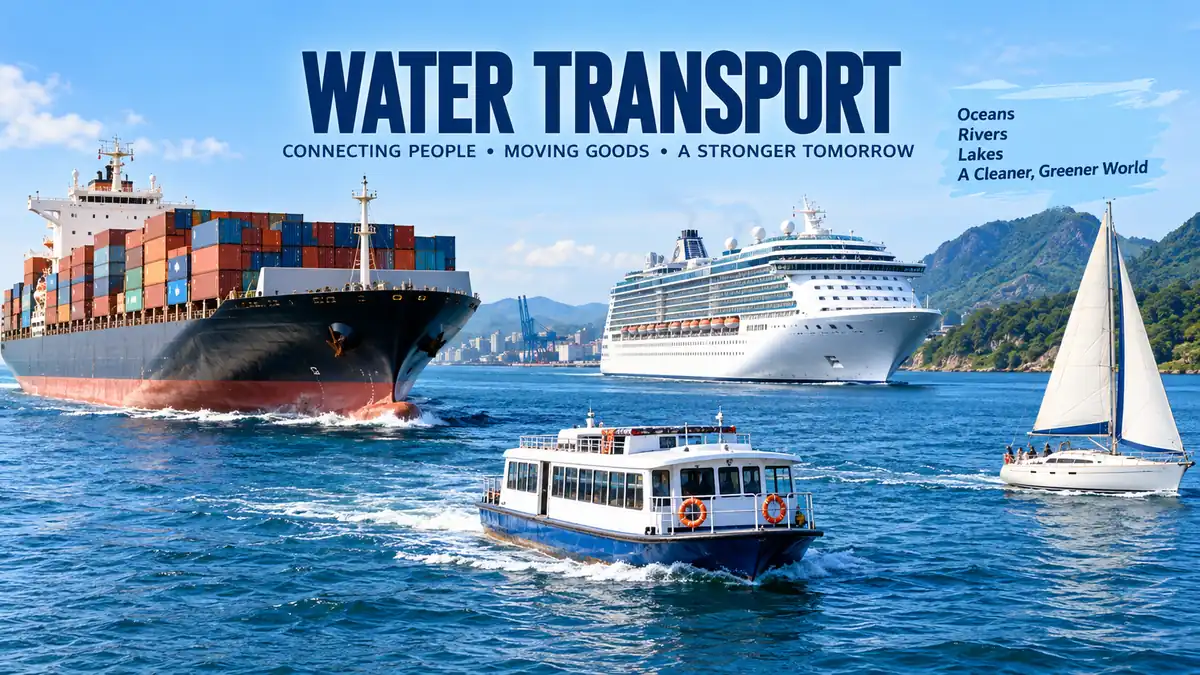
Water transport has carried people and goods for thousands of years, but its importance is far from historical. Modern ships move containers, fuel, food, vehicles, minerals, machinery, and countless other products between countries, while ferries, barges, and river vessels connect communities through inland waterways.
Water transport is the movement of passengers or goods over oceans, seas, rivers, lakes, canals, and other navigable waterways using vessels such as ships, boats, ferries, and barges. It is generally divided into inland water transport and ocean or sea transport and is especially valuable for moving large, heavy, or bulky cargo over long distances.
Its scale is enormous. UN Trade and Development (UNCTAD) reports that maritime transport carries more than 80% of goods traded worldwide by volume, making shipping a fundamental part of international commerce and global supply chains.
Understanding how water transportation works requires looking beyond ships alone. Ports, terminals, navigable channels, canals, cargo-handling equipment, navigation systems, and connections with roads and railways all form part of the wider system.
What Is Water Transport?
Water transport means carrying passengers, freight, or both from one location to another through navigable bodies of water.
The routes can include:
- Oceans
- Seas
- Rivers
- Lakes
- Canals
- Estuaries
- Creeks and backwaters
- Coastal waterways
The vessels range from small canoes and passenger boats to enormous container ships, bulk carriers, tankers, cruise ships, and specialized cargo vessels.
Water transportation is one of the major modes of transport alongside road, rail, air, and pipeline transportation. What distinguishes it is its ability to move exceptionally large quantities of cargo efficiently.
Unlike highways and railways, many waterways already exist naturally. Oceans, rivers, and lakes can therefore provide natural transportation corridors, although ports, channels, locks, navigation aids, dredging, and other infrastructure may still require substantial investment.
Main Types of Water Transport
Water transport can broadly be divided into two major categories: inland water transport and ocean or sea transport.
| Type | Main Routes | Typical Vessels | Common Uses |
|---|---|---|---|
| Inland water transport | Rivers, lakes and canals | Barges, boats, ferries | Bulk freight and passengers |
| Coastal shipping | Routes along coastlines | Cargo ships, ferries | Domestic and regional trade |
| Ocean transport | Seas and oceans | Container ships, tankers, bulk carriers | International trade |
| Passenger water transport | Rivers, lakes, coasts and seas | Ferries, boats, cruise ships | Commuting and tourism |
Inland Water Transport
Inland water transport takes place on navigable waterways within or between land areas rather than across the open ocean.
These waterways primarily include rivers, canals, lakes, and suitable estuaries. Eurostat, for example, defines a navigable inland waterway as a non-sea watercourse that is naturally or artificially suitable for navigation, including navigable rivers, lakes, canals, and estuaries.
Inland transportation may use:
- Barges
- Tugboats
- Ferries
- Riverboats
- Small cargo vessels
- Passenger boats
- Roll-on/Roll-off vessels
Barges are particularly useful for commodities such as coal, grain, ore, construction materials, and petroleum products.
In some regions, inland waterways supplement busy road and railway networks. The United Nations Economic Commission for Europe (UNECE), for instance, describes inland water transport as a viable alternative or addition to road and rail on European transport corridors.
River Transport
Rivers have been natural transportation corridors since ancient civilizations began trading with neighboring settlements.
Modern river transportation can move both passengers and freight. Its usefulness, however, depends heavily on navigability.
A river suitable for regular commercial navigation generally needs sufficient:
- Water depth
- Channel width
- Clearance
- Flow conditions
- Terminal infrastructure
Seasonal changes can create problems. Drought may reduce water depth, while floods, sedimentation, ice, rapids, or strong currents can restrict navigation.
Canal Transport
Canals are artificial waterways constructed or modified for purposes that can include navigation.
Some canals connect rivers and inland industrial regions, while strategically important maritime canals connect seas and oceans.
Two famous examples are the Suez Canal and Panama Canal.
The Suez Canal provides a crucial connection between the Mediterranean and Red Sea, reducing the need for ships traveling between Europe and Asia to sail around Africa. The Panama Canal provides a maritime connection between the Atlantic and Pacific oceans.
Their significance shows how a relatively narrow waterway can influence global shipping routes, voyage distances, freight costs, and supply chains.
Lake Transport
Large navigable lakes can support substantial passenger and freight traffic.
Lake transportation is especially useful where cities, industrial areas, mines, farms, or communities lie around the same connected lake system.
The Great Lakes–St. Lawrence system in North America is a well-known example of an extensive inland navigation network connected to the Atlantic Ocean.
Ocean and Sea Transport
Ocean transport involves moving cargo or passengers through seas and oceans, normally between seaports.
This is the most important form of water transport for international freight.
Modern maritime shipping connects manufacturers, agricultural producers, mines, energy suppliers, distributors, and consumers across continents. Raw materials may travel to manufacturing centers by bulk carrier, while finished products frequently move through containerized shipping.
UNCTAD describes maritime transport as the backbone of global trade, with more than 80% of internationally traded goods by volume moving by sea.
Coastal Shipping
Coastal shipping moves cargo or passengers between ports along the same country’s coastline or within a relatively limited coastal region.
It can reduce pressure on highways and railways, particularly where major cities and industrial centers are located near the coast.
Cargo does not necessarily remain on water throughout its journey. A shipment may arrive at a coastal port before continuing inland by train or truck.
This combination is known as intermodal or multimodal transport.
Common Water Transport Vehicles
A common question is: What are the examples of water transport?
The answer extends well beyond ordinary boats.
Ships
Ships are large vessels designed for ocean, coastal, or sometimes inland navigation. Different ships are built around specific passenger or cargo requirements.
Container Ships
Container ships carry standardized intermodal containers.
Containerization transformed international logistics because the same container can be transferred between ships, trains, and trucks without unloading every individual item inside it.
They commonly carry manufactured products such as electronics, clothing, machinery, furniture, and consumer goods.
Bulk Carriers
Bulk carriers transport unpackaged dry commodities in large quantities.
Typical cargo includes:
- Coal
- Grain
- Iron ore
- Minerals
- Cement-related materials
- Fertilizer
Their large carrying capacity makes maritime transportation particularly suitable for industries that need to move huge quantities of raw materials.
Tankers
Tankers are designed primarily for liquid or gaseous cargo.
Depending on vessel design, cargo may include crude oil, refined petroleum products, chemicals, or liquefied gases.
Specialized construction and operational procedures are required because many tanker cargoes create environmental or safety risks if improperly handled.
Barges
Barges are flat-bottomed vessels widely associated with rivers and canals.
Some are self-propelled, while others are pushed or pulled by tugboats. They are particularly effective for bulk freight on inland waterways.
Ferries
Ferries operate scheduled services across relatively short water routes.
They may transport:
- Pedestrians
- Cars
- Motorcycles
- Buses
- Trucks
- Rail vehicles
Roll-on/Roll-off, or Ro-Ro, ferries allow vehicles to drive onto and off the vessel, making them particularly useful where a body of water separates road networks.
Boats
“Boat” is a broad term covering numerous smaller watercraft, including motorboats, sailboats, fishing boats, riverboats, and passenger craft.
Boats are commonly used for short-distance transportation, fishing, tourism, recreation, and local community access.
Cruise Ships
Cruise ships primarily transport passengers for tourism and leisure rather than simply moving them between two destinations.
They combine transportation with accommodation, dining, entertainment, and recreational facilities.
How Does Water Transport Work?
A modern freight journey usually involves considerably more than sailing from one port to another.
A simplified shipment may follow these steps:
- Cargo reaches a terminal. Goods arrive at a seaport or inland terminal, commonly by truck or rail.
- Cargo is prepared and loaded. Containers, bulk commodities, vehicles, or liquids are transferred onto an appropriate vessel.
- The vessel follows a navigable route. Ships use established shipping lanes while inland craft travel through navigable rivers, lakes, and canals.
- Navigation and traffic are managed. Crews use charts, positioning systems, radar, communications, weather information, and port instructions.
- The vessel reaches its destination port. Pilots and tugboats may assist larger ships in restricted waterways or harbors.
- Cargo is unloaded. Cranes, pumps, conveyor systems, ramps, or specialized terminal equipment transfer it ashore.
- The journey continues inland. Road, rail, pipeline, or another water service handles the next stage when necessary.
This last stage explains one of the most important limitations of shipping: water transport rarely provides universal door-to-door delivery.
Why Is Water Transport Important?
The importance of water transport comes primarily from scale.
A single large commercial vessel can carry far more freight than an individual truck, train wagon, or aircraft. That makes shipping particularly effective when enormous quantities must travel over long distances.
International Trade
International maritime trade connects economies separated by oceans.
Shipping enables countries to import resources they lack and export products in which they specialize.
Global supply chains depend on vessels carrying everything from crude oil and iron ore to grain, vehicles, electronics, and manufactured goods.
According to UNCTAD’s 2025 maritime transport data, the world fleet reached approximately 112,500 vessels and 2.44 billion deadweight tons by January 2025.
Movement of Heavy and Bulky Goods
Water transport is particularly well suited to freight with a high weight or volume relative to its value.
Examples include:
- Coal
- Iron ore
- Timber
- Grain
- Petroleum
- Cement and clinker
- Machinery
- Vehicles
- Construction materials
- Containers
Transporting such quantities by aircraft would generally be impractical, while moving equivalent volumes by road could require very large numbers of trucks.
Connecting Communities
Not every water transportation system exists primarily for global trade.
Ferries and smaller boats can provide essential connections between islands, across rivers, and among communities where constructing bridges, highways, or railways would be difficult or expensive.
Tourism
Water-based passenger transport also supports tourism.
Cruise ships, sightseeing boats, river cruises, ferries, and recreational vessels create connections to coastal cities, islands, historic waterways, and natural attractions.
Advantages of Water Transport
Why is water transport often considered economical? The main reason is the relationship between carrying capacity, distance, and energy use.
1. Large Carrying Capacity
Perhaps its clearest advantage is the ability to carry huge loads.
Commercial ships can move thousands of containers or very large quantities of bulk commodities on a single voyage.
This makes shipping particularly attractive for high-volume freight.
2. Suitable for Heavy and Bulky Cargo
Ships and barges can handle commodities that would be difficult or expensive to transport in comparable quantities by air or road.
Coal, ore, petroleum, grain, timber, machinery, and construction materials are classic examples.
3. Economical for Large Shipments
When large quantities travel long distances, the transport cost per unit of cargo can be relatively low.
This does not mean every water journey is cheap. Port charges, fuel, vessel costs, insurance, canal fees, cargo handling, and inland connections all affect the final cost.
The economic advantage is strongest when freight is large-volume and not extremely time-sensitive.
4. Natural Routes Are Available
Oceans and many rivers provide natural rights of way.
Road and railway systems require continuous constructed infrastructure along their entire routes. Ocean vessels primarily require suitable ports and safe navigable passages rather than a physical road between continents.
NCERT geography material identifies this absence of continuous route construction as one of water transportation’s major advantages.
5. Useful for International Commerce
Ships connect virtually every major trading region with access to navigable seas.
That geographic reach makes maritime transportation indispensable to the global economy.
6. Can Reduce Pressure on Roads
Moving suitable freight onto rivers, canals, and coastal routes can supplement road and rail systems.
India’s Ministry of Ports, Shipping and Waterways, for example, identifies inland waterways as a potentially cost-effective way of supplementing heavily used road and railway networks.
7. Energy Efficient for Bulk Freight
Moving large loads together can provide strong energy efficiency per tonne of cargo transported.
This is one reason inland navigation is frequently discussed as part of sustainable freight systems.
However, describing shipping simply as “environmentally friendly” misses an important qualification: ships still generate greenhouse gases and air pollutants when they use conventional fossil fuels.
Disadvantages of Water Transport
The same characteristics that make shipping efficient also create limitations.
| Advantage | Corresponding Limitation |
|---|---|
| Huge cargo capacity | Usually slower |
| Economical for bulk freight | May involve longer transit times |
| Natural waterways | Routes are geographically restricted |
| Long-distance capability | Requires ports and terminals |
| Efficient per unit of freight | Ships can still produce substantial emissions |
| Excellent for bulk cargo | Poor choice for many urgent shipments |
1. Slow Speed
Speed is one of the biggest disadvantages.
Ocean voyages can take days or weeks. Inland vessels can also be slower than road or rail.
For urgent documents, emergency supplies, high-value time-sensitive components, or some perishable products, air or road transportation may therefore be preferable.
2. Limited Accessibility
Ships cannot travel everywhere.
A factory hundreds of kilometers from a navigable waterway still needs road or railway connections.
This creates the first-mile and last-mile problem: water transportation often forms only one part of the complete journey.
3. Dependence on Ports
Commercial maritime transport requires ports, terminals, cargo-handling equipment, storage areas, and connections with inland logistics networks.
While the ocean itself does not need to be constructed, modern port infrastructure can be extremely expensive.
4. Weather and Natural Conditions
Fog, storms, high winds, ice, floods, drought, and other natural conditions can affect vessel operations.
For inland waterways, insufficient water depth can be especially serious.
River navigation may also be restricted by:
- Rapids
- Waterfalls
- Sandbars
- Sedimentation
- Narrow channels
- Low bridges
- Seasonal freezing
5. Port Congestion and Delays
A vessel arriving on time does not guarantee that its cargo will immediately continue its journey.
Congested terminals can create queues and disrupt schedules.
UNCTAD reported that between December 2023 and March 2024 average port waiting times increased to 6.4 hours in developed economies and 10.9 hours in developing economies, illustrating how disruptions can affect maritime logistics.
6. Environmental Risks
Water transport can cause:
- Greenhouse gas emissions
- Air pollution
- Oil spills
- Fuel leaks
- Underwater noise
- Waste pollution
- Disturbance of marine ecosystems
- Transfer of invasive species
A major spill can damage marine and coastal ecosystems far beyond the immediate accident site.
Water Transport vs Road, Rail and Air Transport
No transportation mode is best for every journey.
| Factor | Water | Road | Rail | Air |
|---|---|---|---|---|
| Speed | Slow | Moderate-fast | Moderate | Very fast |
| Bulk capacity | Very high | Low-moderate | High | Low |
| Door-to-door access | Poor | Excellent | Limited | Limited |
| Heavy cargo suitability | Excellent | Moderate | Excellent | Poor |
| Long-distance international freight | Excellent | Limited | Route-dependent | Excellent |
| Infrastructure dependency | Ports/waterways | Roads | Tracks/terminals | Airports |
| Best use | Bulk, containers, long-distance freight | Flexible delivery | Heavy inland freight | Urgent/high-value cargo |
The choice therefore depends on what is being transported.
A shipment of iron ore traveling thousands of kilometers is naturally suited to bulk shipping. An urgent medical package traveling between continents is better suited to air freight. A parcel going from a warehouse to someone’s house normally needs road transport.
Modern logistics consequently combines several modes rather than treating them as competitors.
Inland Waterways and Their Economic Role
Inland waterways occupy a useful position between maritime and land transportation.
They can connect agricultural areas, industrial regions, mines, cities, and seaports while supporting passenger movement.
A functioning inland waterway system depends on more than simply having a river.
Commercial navigation may require:
- Adequate channel depth
- Dredging
- Locks and dams
- Navigation aids
- Bridges with sufficient clearance
- River ports
- Cargo terminals
- Vessel traffic management
- Reliable water levels
This explains why two apparently similar rivers may have completely different transportation importance.
UNECE has developed agreements, standards, resolutions, and terminology for European inland navigation, reflecting the operational and regulatory complexity of modern inland water transport. Its glossary alone contains more than 700 terms and definitions related to inland waterways, vessels, navigation, and passenger and freight transportation.
Water Transport and Global Supply Chains
Maritime transport does more than move finished products between countries. It links multiple stages of production.
Consider a manufactured vehicle.
Raw materials may first travel aboard bulk carriers. Components manufactured in several countries can move by container ship. Completed vehicles may then be transported aboard specialized Ro-Ro vessels before trucks or trains deliver them from the destination port.
That interconnected system explains why disruption at a major maritime chokepoint can affect businesses far away.
Recent events have made this particularly visible.
UNCTAD’s Review of Maritime Transport 2025 reported that geopolitical disruption and rerouting increased sailing distances, with ton-miles rising 5.9% during 2024. By May 2025, tonnage passing through the Suez Canal remained 70% below 2023 levels.
Ships can take alternative routes, but doing so may increase voyage time, fuel consumption, freight costs, and emissions.
Quick takeaway: Water routes may look like open highways, but global shipping depends on ports, canals, straits, safe passages, predictable schedules, and well-connected inland transport networks.
Is Water Transport Environmentally Friendly?
Water transport can be highly efficient per unit of freight moved, particularly when comparing large bulk shipments with moving equivalent cargo in many individual road vehicles.
But efficiency does not make shipping emission-free.
Most of the existing world fleet still relies on conventional fuels. UNCTAD reported that although alternative-fuel vessels represented more than half of the tonnage on order, over 90% of the active fleet still operated on conventional fuels in 2025.
The maritime industry is therefore under pressure to reduce greenhouse gas emissions while continuing to handle growing and changing trade flows.
The International Maritime Organization (IMO) adopted its 2023 Strategy on Reduction of GHG Emissions from Ships with an ambition for international shipping to reach net-zero greenhouse gas emissions by or around 2050.
The strategy also includes indicative checkpoints of reducing total annual international-shipping GHG emissions by at least 20%, while striving for 30%, by 2030, and at least 70%, while striving for 80%, by 2040, compared with 2008 levels.
Potential changes include cleaner or near-zero-emission fuels, improved ship design, greater energy efficiency, better route optimization, port electrification, and digital technologies.
What Determines Whether a Waterway Is Navigable?
Not every river, lake, or coastal area can support commercial vessels.
Several physical and infrastructure factors determine navigability.
Water Depth
A vessel needs sufficient depth for its draft—the vertical distance between the waterline and the lowest part of the hull.
Low water can force operators to reduce cargo loads or suspend navigation.
Width and Channel Shape
Large vessels require adequate channel width, especially when turning or passing other vessels.
Water Flow
Strong currents can make navigation difficult and increase energy consumption.
Seasonal Conditions
Drought, floods, and ice can make otherwise useful waterways unreliable during part of the year.
Physical Obstacles
Rapids, waterfalls, rocks, sandbars, low bridges, and other obstacles can restrict vessel movement.
Engineering works such as locks, dams, dredged channels, and canals may overcome some of these problems, but they require investment and maintenance.
Ports: The Link Between Water and Land
A port is much more than somewhere a ship stops.
Modern ports function as logistics hubs connecting maritime routes with road, rail, inland waterways, pipelines, warehouses, and distribution centers.
Depending on their purpose, ports may contain:
- Container terminals
- Bulk cargo terminals
- Oil and gas terminals
- Passenger terminals
- Warehouses
- Storage tanks
- Cranes
- Conveyor systems
- Customs facilities
- Rail connections
- Truck terminals
Containerization has made this connection particularly efficient because standardized containers can move between different transportation modes.
A container can leave a factory by truck, travel to a railway terminal, continue to a seaport by train, cross an ocean aboard a container ship, and finish its journey by truck without its individual contents being repeatedly unpacked.
What Goods Are Best Suited to Water Transport?
Water transportation works best when volume and carrying capacity matter more than speed.
Typical examples include dry bulk commodities such as coal, iron ore, grain, sand, and minerals; liquid bulk cargo such as petroleum and chemicals; containerized manufactured goods; vehicles; timber; machinery; and oversized industrial equipment.
It can also carry refrigerated products in specialized vessels or containers.
For time-sensitive or highly perishable goods, however, the slower journey may outweigh the cost advantage. The decision depends on cargo value, shelf life, distance, delivery deadline, available routes, and total logistics cost.
The Future of Water Transport
Water transportation is changing rather than disappearing.
Three developments are particularly significant.
Decarbonization is pushing shipowners, regulators, ports, and fuel suppliers toward lower-carbon and zero- or near-zero-GHG technologies and energy sources.
Digitalization is changing navigation, cargo tracking, port management, documentation, scheduling, and supply-chain visibility. At the same time, greater digital dependence introduces cybersecurity risks, an issue highlighted in UNCTAD’s 2025 maritime transport review.
Resilience has also become central. Geopolitical tensions, climate-related disruption, congestion, changing trade policies, and blocked or restricted routes have demonstrated that efficient shipping networks also need alternatives when normal routes fail.
The future is therefore likely to involve cleaner vessels, smarter ports, improved inland waterways, greater automation, better data sharing, and closer integration between water, rail, and road networks.
Why Water Transport Still Matters
Water transport remains one of the foundations of modern transportation because few alternatives can match its ability to move enormous quantities of freight across long distances.
Its two major forms—inland waterways and sea transport—serve different geographical needs, while vessels such as barges, ferries, container ships, bulk carriers, and tankers handle everything from daily passenger journeys to international commodity flows.
Its advantages are substantial: high carrying capacity, suitability for heavy and bulky goods, natural route availability, and economical long-distance freight movement. Its disadvantages are equally important to understand: slower speeds, limited direct accessibility, dependence on ports and navigable waterways, weather exposure, environmental impacts, and potential supply-chain delays.
With more than 80% of internationally traded goods by volume moving by sea, water transport is not simply an old method of getting from one place to another. It remains a core part of the infrastructure that connects economies, industries, communities, and global supply chains.