Few relationships in Hindu spiritual tradition have inspired as much poetry, music, art, and devotion as radha krishna. Their story goes beyond ordinary romance, expressing a profound connection between the human soul and the divine.
radha krishna represents divine love, devotion, and spiritual union in Hinduism, particularly within Vaishnavism and the Bhakti tradition. Radha embodies selfless love and devotion, while Krishna is revered as the Supreme Divine or an incarnation of Vishnu, depending on the tradition. Together, they symbolize the soul’s longing for and loving relationship with God.
Their relationship has been celebrated for centuries through sacred literature, devotional songs, temple worship, classical dance, and religious festivals. Understanding their story offers insight into the Hindu concepts of prema (divine love), bhakti (devotion), and the search for spiritual fulfillment.
Who Are Radha and Krishna in Hinduism?
Radha and Krishna are central figures in several Hindu devotional traditions. Although their stories are closely connected, each has a distinct theological and spiritual significance.
Who Is Lord Krishna?
Krishna is one of Hinduism’s most widely worshipped deities. In many Vaishnava traditions, he is regarded as an avatar of Lord Vishnu. In others, especially Gaudiya Vaishnavism, Krishna is worshipped as the original Supreme Personality of Godhead, or Svayam Bhagavan.
Krishna’s life is traditionally associated with several important locations, including Mathura, Gokul, Vrindavan, and Dwarka.
His divine activities, known as lila, include childhood adventures, the lifting of Govardhan Hill, his relationships with the cowherd community of Braj, and his teachings to Arjuna in the Bhagavad Gita.
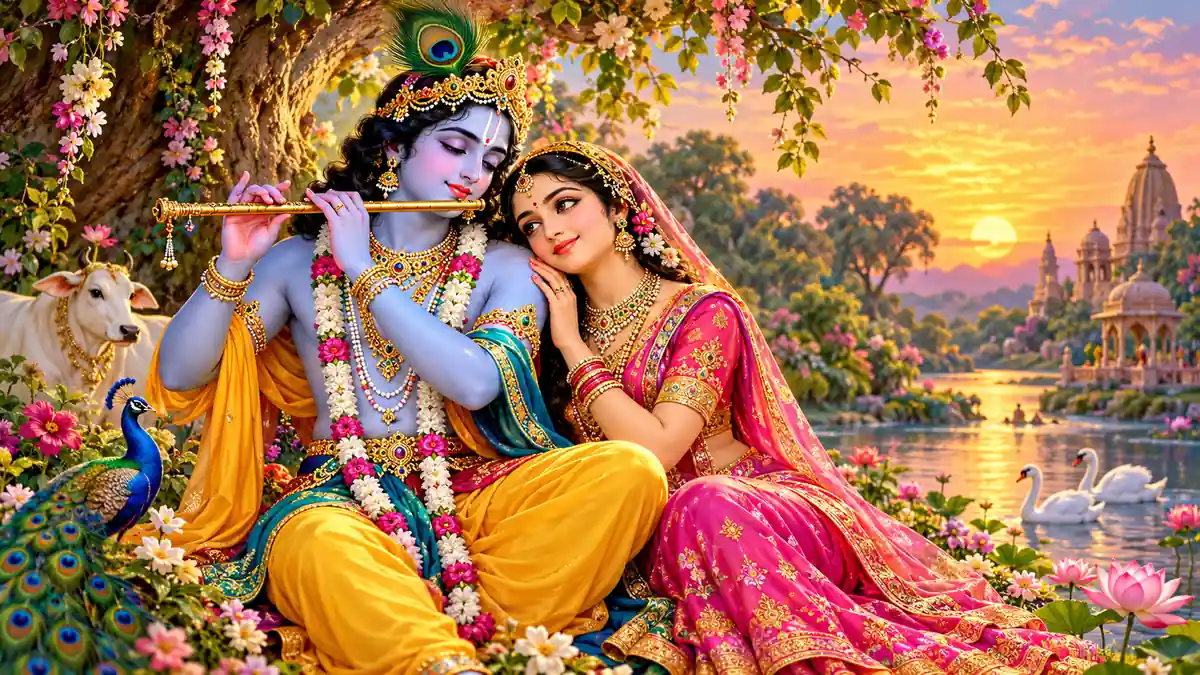
Krishna is commonly depicted with blue or dark-colored skin, playing a flute and wearing a peacock feather in his crown.
These visual elements carry symbolic meaning. His flute is especially associated with the divine call that draws devotees toward spiritual love.
Who Is Radha?
Radha, also called Radharani, Radha Rani, or Shrimati Radharani, is revered as Krishna’s beloved and, in many Vaishnava traditions, the highest expression of devotion to him.
In Gaudiya Vaishnava theology, Radha is understood as Krishna’s hladini shakti, the divine pleasure potency through which divine love and bliss are expressed.
Radha is therefore much more than a romantic figure. She represents the fullest expression of loving devotion and the transformative power of selfless spiritual attachment.
Her identity is especially prominent in the devotional traditions of Braj, where devotees greet one another with expressions such as “Radhe Radhe.”
Why Are Radha and Krishna Worshipped Together?
Radha and Krishna are worshipped together because their relationship represents the inseparable connection between divine love and its beloved object.
Krishna is the focus of devotion, while Radha represents the highest perfection of that devotion.
In some theological traditions, they are understood as two manifestations of one divine reality.
Their united form communicates an important spiritual teaching: love is not simply an emotion but a means of experiencing the divine.
The Story of radha krishna and Their Eternal Love
The love story of Radha and Krishna is traditionally set in the pastoral landscape of Vrindavan, where Krishna spent much of his childhood and youth.
Their relationship appears in different forms across devotional poetry, regional storytelling, religious literature, and Vaishnava theological traditions.
Because these accounts developed across centuries, there is no single narrative accepted identically by every Hindu community.
The Childhood of Krishna in Vrindavan
According to Hindu tradition, Krishna was born in Mathura to Devaki and Vasudeva during the rule of King Kamsa.
To protect him from Kamsa, Krishna was taken to the care of Nanda and Yashoda in the cowherd community of Gokul.
His childhood stories later unfold across the wider Braj region, including Vrindavan.
Krishna’s playful activities include stealing butter, tending cows, playing his flute, and performing extraordinary acts to protect the villagers.
The forests, riverbanks, and flowering groves of Vrindavan became the sacred setting for stories of his divine love.
How Did Radha and Krishna Meet?
Popular devotional narratives describe Radha and Krishna encountering one another in the villages and forests of Braj.
Some traditions place their early meetings near Barsana, traditionally associated with Radha, and Nandgaon, associated with Krishna.
Other accounts describe their first meeting differently.
These stories are especially prominent in regional devotional literature and later retellings rather than in one universally accepted historical account.
What remains consistent is the spiritual significance of their connection: Radha’s love for Krishna is portrayed as complete, unconditional, and beyond ordinary worldly attachment.
The Divine Raas Leela
One of the most celebrated events associated with Krishna is the Rasa Lila, also written as Raas Leela.
The Bhagavata Purana describes Krishna’s divine dance with the gopis, or cowherd women, of Vrindavan.
The narrative emphasizes their intense devotion and Krishna’s extraordinary ability to reciprocate with his devotees.
In later Radha-centered devotional traditions, Radha occupies a uniquely exalted position within the divine dance.
The Rasa Lila is interpreted by many Vaishnava teachers as a spiritual expression of pure devotion rather than an ordinary romantic encounter.
Its symbolism includes the longing of the soul, the joy of divine presence, and the relationship between the individual devotee and the Supreme.
Why Did Radha and Krishna Separate?
A central theme in their devotional story is separation.
Krishna eventually leaves the pastoral world of Braj and travels to Mathura, where he confronts Kamsa.
Radha remains closely associated with Vrindavan and the devotional experience of longing for Krishna.
In many poetic traditions, this physical separation deepens rather than diminishes their spiritual relationship.
The experience is called viraha, or separation from the beloved.
In devotional theology, longing for God can intensify remembrance, surrender, and love.
The separation of Radha and Krishna therefore becomes a metaphor for the soul’s longing to reunite with the divine.
Why Did Radha and Krishna Never Marry?
One of the most frequently asked questions about their relationship is why Radha and Krishna did not marry.
The answer depends on which religious text or devotional tradition is being considered.
In the best-known narrative traditions, Krishna’s later life includes marriages to Rukmini, Satyabhama, and other queens, while Radha’s relationship with him is presented primarily through the theology of divine love.
However, some later traditions describe Radha and Krishna as eternally united or recount a divine marriage.
The Brahma Vaivarta Purana and other later devotional traditions contain accounts that differ from those found in earlier major Krishna narratives.
Consequently, the statement that Radha and Krishna never married is not universally accepted across Hindu traditions.
Spiritual Love Beyond Social Relationships
Many Vaishnava interpretations emphasize that Radha and Krishna’s relationship cannot be adequately understood through ordinary social categories.
Their love is described as eternal and transcendent.
The absence of a conventional marriage narrative in some traditions is interpreted as a way of highlighting devotion that does not depend on worldly recognition or possession.
This does not mean that Hinduism generally considers marriage spiritually inferior.
Rather, Radha and Krishna’s relationship occupies a distinctive theological position within particular devotional traditions.
Is Radha Krishna’s Wife?
Radha is commonly described as Krishna’s eternal consort or divine beloved.
Whether she is called his wife depends on the religious tradition.
Some communities celebrate their eternal divine marriage, while others emphasize their relationship through the devotional concepts of madhurya bhava and parakiya bhava.
Madhurya bhava refers to approaching God through the intimate mood of divine love. Parakiya bhava, particularly in certain theological interpretations, describes love beyond conventional marital identity.
These concepts are understood symbolically and theologically by devotional teachers, rather than as general instructions for human relationships.
The Spiritual Meaning of radha krishna
The spiritual significance of radha krishna extends far beyond the details of their narrative.
Their relationship has become one of the most influential symbols of divine love in the Bhakti movement.
Radha Represents the Highest Form of Bhakti
Bhakti is the path of loving devotion to God.
Within Radha-centered Vaishnavism, Radha is regarded as the supreme devotee because her love is entirely focused on Krishna’s happiness.
Her devotion is traditionally characterized by selflessness, surrender, unwavering remembrance, and the absence of selfish expectations.
This form of spiritual love is often called prema bhakti.
Unlike devotion motivated primarily by personal rewards, prema bhakti emphasizes love for the divine as an end in itself.
Krishna Represents the Supreme Divine
Krishna is worshipped as the supreme object of love in several Vaishnava traditions.
His beauty, flute, playful activities, and compassionate interactions with devotees represent different aspects of divine personality.
In Krishna-centered devotion, God is not understood only as an abstract cosmic power.
The divine can also be approached through an intimate, personal relationship characterized by affection, friendship, parental care, or love.
The Relationship Between Atma and Paramatma
Radha and Krishna are sometimes explained symbolically through the relationship between atma, the individual self, and Paramatma, the Supreme Self.
In this interpretation, Radha’s longing represents the soul’s desire for divine closeness.
However, this symbolic explanation should not be confused with every Vaishnava school’s precise theology.
Gaudiya Vaishnavism, for example, understands Radha as Krishna’s eternal internal potency, not merely an ordinary individual soul.
Both interpretations help explain why the relationship carries profound spiritual meaning for different devotees.
The Meaning of Divine Separation
The Sanskrit concept of viraha describes the emotional and spiritual experience of separation from the beloved.
In Radha-Krishna devotion, separation is not simply sadness.
It can become a powerful expression of remembrance and spiritual absorption.
The devotee’s longing for Krishna is understood as evidence of an intense and enduring relationship with the divine.
This theme appears throughout devotional poetry, especially in works inspired by the emotional world of Vrindavan.
Radha Krishna in Hindu Scriptures and Sacred Literature
The story and theology of Radha and Krishna developed through several layers of Hindu literature.
Understanding these sources helps distinguish early scriptural narratives from later devotional interpretations.
| Sacred text or literary work | Connection to Radha and Krishna |
|---|---|
| Bhagavata Purana | Describes Krishna’s childhood, Vrindavan pastimes, gopis, and Rasa Lila |
| Gita Govinda | Celebrates the love, longing, separation, and reunion of Radha and Krishna |
| Brahma Vaivarta Purana | Contains prominent Radha-Krishna narratives and theological descriptions |
| Brahma Samhita | Influential in Gaudiya Vaishnava theology concerning Krishna and his divine realm |
| Chaitanya Charitamrita | Explains Radha-Krishna theology through the teachings and life of Chaitanya Mahaprabhu |
| Surdas’s devotional poetry | Celebrates Krishna’s life and the emotional world of Braj devotion |
Radha in the Bhagavata Purana
The Bhagavata Purana is among the most influential sources for Krishna’s divine activities.
Its tenth book describes Krishna’s childhood, the gopis, and the Rasa Lila.
However, Radha is not explicitly named in the commonly received Sanskrit text of the Bhagavata Purana.
Some Vaishnava commentators interpret the especially favored gopi described in Book 10, Chapter 30, as Radha.
This distinction matters because Radha’s later theological prominence cannot be understood simply by assuming that every major early Krishna text names her directly.
The Gita Govinda by Jayadeva
The Gita Govinda is one of the most influential works devoted to Radha and Krishna’s love.
Composed by the poet Jayadeva in the 12th century, it explores their separation, longing, reconciliation, and emotional intimacy.
The work combines lyrical poetry, music, and theological symbolism.
It became especially influential in eastern India and helped shape later devotional performance, painting, and classical dance.
Chaitanya Mahaprabhu and Gaudiya Vaishnavism
Chaitanya Mahaprabhu played a major role in the development of Radha-Krishna devotion.
His teachings emphasized congregational chanting, intense love of Krishna, and the spiritual importance of Radha’s devotional mood.
Gaudiya Vaishnava theology regards Chaitanya as Krishna appearing with Radha’s devotional disposition and divine complexion.
Later teachers, including Rupa Goswami, Sanatana Goswami, and Jiva Goswami, developed detailed theological explanations of divine love, devotional relationships, and Krishna’s eternal activities.
These teachings continue to influence Vaishnava communities around the world.
Famous Radha Krishna Temples and Sacred Places
The Braj region of Uttar Pradesh is the spiritual heart of Radha-Krishna devotion.
Its temples, villages, forests, and sacred water bodies preserve traditions associated with their divine activities.
Vrindavan: The Sacred Land of Divine Love
Vrindavan is one of the most important pilgrimage destinations for Krishna devotees.
According to Hindu tradition, its forests and groves witnessed many of Krishna’s childhood activities and divine pastimes.
Several prominent temples are associated with Radha-Krishna worship:
- Banke Bihari Temple: Famous for its distinctive worship of Krishna as Banke Bihari.
- Prem Mandir: Known for its elaborate architecture and artistic depictions of divine pastimes.
- Radha Raman Temple: An important historic temple in the Gaudiya Vaishnava tradition.
- Radha Vallabh Temple: Associated with a devotional tradition emphasizing Radha’s supreme spiritual position.
- ISKCON Krishna Balaram Mandir: An important center for international Krishna devotion, congregational chanting, and scriptural study.
Vrindavan is also associated with Seva Kunj and Nidhivan, places that hold special significance in local devotional traditions.
Barsana: The Traditional Home of Radha
Barsana is widely revered as Radha’s home and is particularly associated with her childhood and youth.
The town’s famous Radha Rani Temple, also known as Shri Ladli Ji Mandir, stands on a hill overlooking the surrounding landscape.
Barsana is especially celebrated during Radhashtami and Lathmar Holi.
In local tradition, Radha’s father is named Vrishabhanu, while her mother is commonly known as Kirtida.
Some devotional accounts associate Radha’s birth with nearby Raval, illustrating the diversity of sacred geographical traditions.
Radha Kund and Govardhan
Radha Kund is a sacred bathing pond near Govardhan Hill.
Within Gaudiya Vaishnavism, it is regarded as one of the holiest places associated with Radha and Krishna.
Nearby Shyama Kund is associated with Krishna.
Devotees visit these locations for prayer, remembrance, and pilgrimage.
Govardhan Hill is also central to Krishna’s story. The Bhagavata Purana describes Krishna lifting the hill to protect the inhabitants of Braj from torrential rain.
Radha Krishna Festivals and Religious Celebrations
Radha and Krishna are honored throughout the Hindu religious calendar.
Their festivals bring together temple worship, devotional music, storytelling, fasting, and community celebrations.
| Festival | Main significance | Common traditions |
|---|---|---|
| Krishna Janmashtami | Celebrates Krishna’s birth | Fasting, midnight worship, devotional singing |
| Radhashtami | Celebrates Radha’s divine appearance | Special prayers, abhisheka, flower decorations |
| Holi | Celebrates spring and Krishna’s playful traditions | Colored powders, music, community festivities |
| Jhulan Yatra | Celebrates the divine couple during the monsoon | Decorated swings, devotional songs |
| Sharad Purnima | Associated with the Rasa Lila | Nighttime worship and devotional performances |
| Kartik observances | Period of intensified Krishna devotion | Lamp offerings, chanting, and temple worship |
Krishna Janmashtami
Janmashtami commemorates Krishna’s birth and is celebrated widely across India and Hindu communities worldwide.
Devotees may observe fasting, chant sacred names, decorate temples, and participate in midnight worship.
In Mathura and Vrindavan, celebrations are closely connected to Krishna’s traditional birthplace and childhood.
Radhashtami
Radhashtami honors the divine appearance of Radharani.
It falls on the eighth lunar day of the bright fortnight of Bhadrapada, generally in August or September.
Devotees may observe fasting, offer flowers, sing bhajans, and participate in special temple ceremonies.
Celebrations in Barsana and Vrindavan are particularly significant.
ISKCON+1
Holi and the Traditions of Braj
Holi is strongly associated with Krishna’s playful interactions with Radha and the gopis.
The celebrations of Barsana and Nandgaon include the famous Lathmar Holi tradition.
Devotional singing, colorful processions, and reenactments of Krishna’s pastimes are also common across Braj.
These celebrations preserve both religious symbolism and regional cultural heritage.
Radhakrishna+1
Radha Krishna Mantras, Bhajans, and Daily Worship
Devotion to Radha and Krishna is expressed through prayer, chanting, meditation, temple rituals, and acts of service.
Different Vaishnava communities follow different forms of worship, but sincere devotion remains a central principle.
Popular Radha Krishna Mantras
One widely recognized devotional chant is:
Hare Krishna Hare Krishna, Krishna Krishna Hare Hare
Hare Rama Hare Rama, Rama Rama Hare Hare
This sixteen-name mantra is particularly prominent in the Gaudiya Vaishnava tradition and the International Society for Krishna Consciousness (ISKCON).
Another simple devotional expression is:
Radhe Radhe
It is frequently used as a greeting, prayer, and expression of devotion in the Braj region.
The chant Radhe Krishna is also common among devotees who wish to remember the divine couple together.
How to Worship Radha Krishna at Home
A simple home devotional practice can include:
- Prepare a clean space. Place a respectful image or deity representation of Radha and Krishna in a suitable location.
- Offer flowers or a lamp. Traditional offerings may include flowers, incense, or a small oil or ghee lamp.
- Chant divine names. Repeat a familiar mantra or sing devotional songs.
- Read sacred literature. Study passages from the Bhagavad Gita, Bhagavata Purana, or other texts respected in your tradition.
- Practice gratitude and service. Reflect on how devotion can influence daily conduct and relationships.
The exact rituals vary according to family customs, temple practices, and religious lineages.
For many devotees, consistency and sincerity are more meaningful than elaborate arrangements.
The Role of Bhajans and Kirtan
Bhajans are devotional songs, while kirtan commonly involves singing or chanting divine names, often in a group.
Radha-Krishna devotional music includes compositions in Sanskrit, Braj Bhasha, Hindi, Bengali, and several other Indian languages.
These traditions have been shaped by poets and saints such as Surdas, Mirabai, Chandidas, and later Vaishnava composers.
Music helps devotees express feelings that may be difficult to communicate through ordinary speech.
Love, surrender, longing, gratitude, and joy are recurring themes.
Radha Krishna Symbolism in Art and Culture
Radha and Krishna are among the most recognizable subjects in Indian religious art.
Their images appear in temple sculpture, miniature painting, textiles, devotional posters, classical dance, and contemporary visual culture.
The Meaning of Krishna’s Flute
Krishna’s flute is one of his most distinctive attributes.
In devotional interpretation, its music represents the irresistible attraction of divine love.
The flute’s hollow form is sometimes understood as a symbol of surrender: just as a flute produces music through the musician’s breath, the devotee seeks to become receptive to divine guidance.
This is a spiritual interpretation rather than a universally prescribed scriptural explanation.
The Peacock Feather and Lotus
Krishna’s peacock feather is associated with beauty, playfulness, and the natural world of Vrindavan.
The lotus, often included in devotional imagery, symbolizes purity and spiritual beauty.
Radha is frequently depicted wearing richly colored traditional garments, standing beside Krishna in a flowering garden or beneath a tree.
Together, these visual elements evoke the sacred landscape of Braj.
Radha Krishna in Indian Classical Dance
The relationship of Radha and Krishna has inspired major Indian classical dance traditions.
In Odissi, Jayadeva’s Gita Govinda has had a particularly important influence on musical and expressive performance.
Kathak frequently portrays Krishna’s childhood, the Rasa Lila, and the emotional experiences of Radha and the gopis.
Manipuri dance also includes important Rasa Lila traditions, combining movement, music, and religious storytelling.
These performances communicate devotion through gesture, rhythm, facial expression, and dramatic interpretation.
Radha Krishna in Miniature Paintings
Radha-Krishna themes became especially prominent in Indian miniature painting.
Rajasthani and Pahari painting traditions frequently depict the divine couple in gardens, moonlit landscapes, monsoon settings, and intimate devotional scenes.
The Gita Govinda inspired numerous illustrated manuscripts.
For example, the Los Angeles County Museum of Art preserves a seventeenth-century painting depicting Radha and Krishna embracing in a forest setting, illustrating the enduring artistic influence of Jayadeva’s poem.
LACMA Collections
Life Lessons From the Love of Radha Krishna
Although Radha and Krishna occupy a sacred position within Hindu theology, their devotional story also encourages reflection on love, humility, patience, and spiritual discipline.
Love Without Possession
Radha’s devotion is traditionally described as selfless.
Her relationship with Krishna is not defined solely by physical proximity or social recognition.
For devotees, this suggests that genuine love involves concern for another’s well-being rather than a desire for control.
In everyday relationships, the principle can encourage generosity, respect, and emotional maturity.
Devotion Requires Consistency
Bhakti is not limited to occasional religious ceremonies.
It can be expressed through regular prayer, ethical conduct, kindness, and service.
The Radha-Krishna tradition encourages devotees to remember the divine through ordinary activities, not only during festivals.
Separation Can Deepen Spiritual Reflection
The devotional concept of viraha shows how longing can become an occasion for reflection and remembrance.
In spiritual practice, absence may encourage deeper contemplation of what is meaningful.
However, this symbolism should not be used to romanticize unhealthy relationships or unnecessary suffering.
Humility Is Central to Spiritual Growth
Radha’s devotion is associated with surrender and the absence of ego-centered expectations.
Many Bhakti teachers emphasize humility as a foundation for spiritual development.
In practical terms, humility can mean listening carefully, recognizing personal limitations, and serving others without constantly seeking praise.
Spiritual Love Extends Beyond Romance
The love of Radha and Krishna is often interpreted as transcending ordinary romantic categories.
Their relationship represents a spiritual ideal rooted in devotion, beauty, and divine connection.
This explains why their story continues to resonate with devotees, poets, artists, and students of Hindu philosophy.
Why Radha Krishna Remains Important Today
Radha and Krishna continue to influence religious practice and cultural expression across India and throughout the Hindu diaspora.
Their devotional traditions have expanded internationally through Vaishnava organizations, temples, festivals, sacred music, and translations of religious literature.
Yet their enduring significance cannot be measured only by the number of temples or celebrations dedicated to them.
For many devotees, Radha and Krishna provide a deeply personal way to understand the relationship between humanity and the divine.
Radha represents the highest aspiration of loving devotion, while Krishna embodies the divine presence toward which that devotion is directed.
Their story also demonstrates how religious meaning can develop through multiple forms of expression.
Sacred texts provide theological foundations. Poetry communicates emotional experience. Music creates shared devotional participation. Art gives visual form to spiritual ideas.
These traditions reinforce one another while preserving distinctive regional and philosophical interpretations.
Conclusion
The story of radha krishna is one of Hinduism’s most enduring expressions of divine love and devotion.
From the sacred landscapes of Vrindavan and Barsana to the poetry of Jayadeva and the teachings of Chaitanya Mahaprabhu, their relationship has inspired generations of spiritual seekers.
Their significance lies not merely in the question of whether they married or experienced separation, but in the deeper meaning that devotional traditions find in their eternal connection.
Radha symbolizes extraordinary love and surrender, while Krishna represents the divine beloved.
Together, they offer a spiritual vision in which love becomes a path toward understanding God.
For anyone seeking to explore this tradition more deeply, reading the Bhagavata Purana alongside the Gita Govinda and studying the interpretations of different Vaishnava schools provides a valuable starting point.