Imagine boarding an aircraft in New York, eating several meals, watching a few movies, sleeping for hours, and waking up to discover you still have a substantial part of the journey left. That is normal on the longest flight in the world, where passengers can spend close to 19 hours continuously in the air.
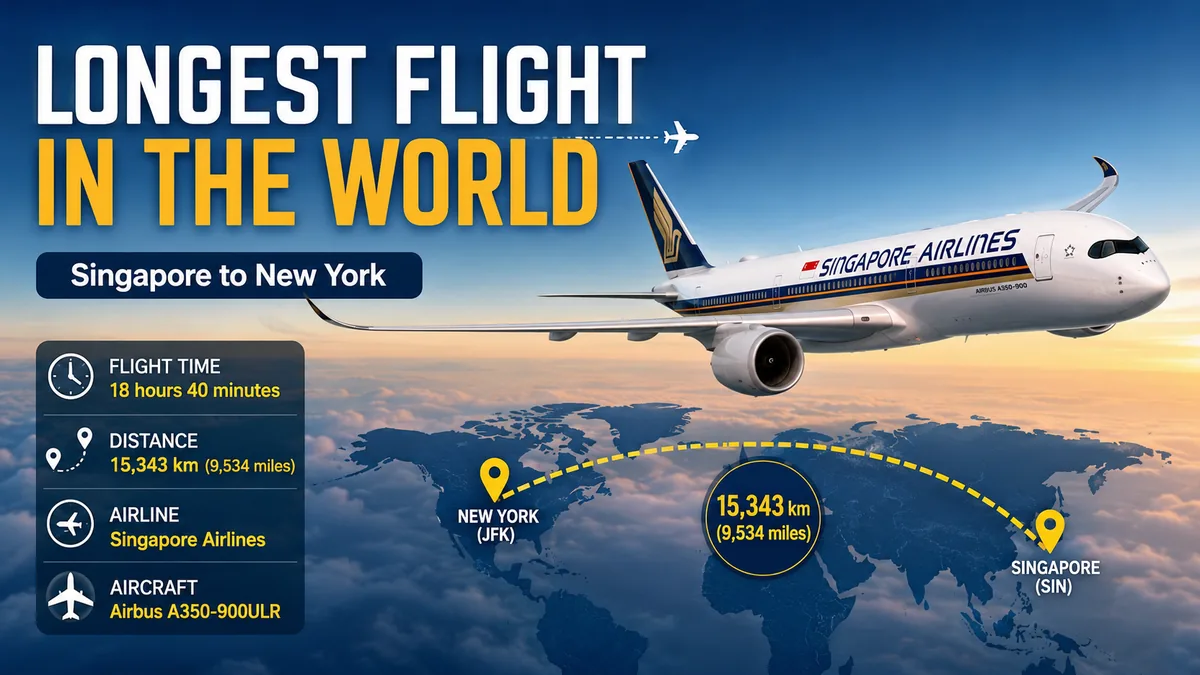
As of August 2026, the longest scheduled nonstop passenger route by great-circle distance is New York JFK to Singapore Changi, operated by Singapore Airlines. The route covers roughly 15,300–15,350 km (about 9,530 miles) and typically takes around 19 hours, using the Airbus A350-900ULR.
That record, however, is approaching a major change. Qantas plans to begin nonstop Sydney–London flights under Project Sunrise in October 2027. At more than 16,000 km and potentially 19–22 hours, the route is designed to become the world’s longest scheduled commercial passenger flight.
What Is the longest flight in the world Right Now?
For travelers asking simply, “What is the longest nonstop flight you can actually take?”, the answer in 2026 is New York JFK–Singapore.
The route connects John F. Kennedy International Airport (JFK) in New York with Singapore Changi Airport (SIN). Singapore Airlines operates the service with an Airbus A350 configured specifically for ultra-long-haul flying.
Here are the key numbers:
| Detail | New York JFK–Singapore |
|---|---|
| Airline | Singapore Airlines |
| Airports | JFK–SIN |
| Flight numbers | SQ23/SQ24 |
| Great-circle distance | About 15,332–15,349 km |
| Distance in miles | About 9,530–9,540 miles |
| Typical/scheduled duration | Roughly 18h 40m–19h 10m |
| Aircraft | Airbus A350-900ULR |
| Cabins | Business and Premium Economy |
| Stops | None |
OAG-based 2026 rankings place JFK–Singapore at approximately 15,332 km, just ahead of Newark–Singapore at roughly 15,329 km. Singapore Airlines itself currently lists its direct New York–Singapore journey at approximately 19 hours 10 minutes.
The small variations you may see between published distances are normal. Different databases can use slightly different airport coordinates or calculation methods.
Is New York to Singapore Really a 19-Hour Flight?
Yes. A scheduled journey can approach 19 hours, although the actual time in the air varies.
The aircraft does not necessarily fly the exact same path every day. Winds, air traffic restrictions, weather, closed airspace and operational considerations can alter both the route and flight time.
That is why one journey might arrive considerably earlier than the timetable suggests while another spends much closer to the full scheduled duration in the air.
How Is the World’s Longest Flight Measured?
Calling something the “longest flight” sounds straightforward until you start comparing routes.
There are several possible measurements:
- Great-circle distance between the departure and arrival airports
- Actual distance flown on a particular day
- Scheduled flight duration
- Actual time in the air
- Total elapsed journey time
Most aviation rankings use great-circle distance, or GCD.
Great-circle distance measures the shortest path between two points on a spherical Earth. This explains why ultra-long-haul routes often look curved when displayed on a flat world map.
Actual aircraft routing can be longer.
Pilots and airline dispatchers may alter the path to account for jet-stream winds, weather systems, airspace restrictions, geopolitical conflicts and other operational factors.
Distance vs. Duration: Which Flight Is Actually Longest?
This distinction matters.
A flight covering fewer kilometres can occasionally have a longer scheduled duration because of headwinds or routing constraints. Conversely, favorable winds can shorten a very long journey.
For a consistent comparison, distance is generally the better measurement.
That is why the JFK–Singapore route is commonly recognized as the current longest scheduled nonstop passenger route even when another service happens to record a longer flight time on a particular day.
Quick Takeaway: When someone refers to the world’s longest commercial flight, they usually mean the longest regularly scheduled nonstop passenger route by great-circle distance—not the longest individual flight ever recorded.
Top 10 Longest Nonstop Flights in the World in 2026
Ultra-long-haul aviation is no longer limited to one remarkable route. Airlines now routinely connect cities separated by more than 14,000 kilometres without stopping for fuel.
Based primarily on OAG-derived 2026 rankings, the leading routes are:
| Rank | Route | Airline | Approx. Distance |
|---|---|---|---|
| 1 | New York JFK–Singapore | Singapore Airlines | 15,332 km |
| 2 | Newark–Singapore | Singapore Airlines | 15,329 km |
| 3 | Auckland–Doha | Qatar Airways | 14,526 km |
| 4 | Perth–London Heathrow | Qantas | 14,499 km |
| 5 | Dallas/Fort Worth–Melbourne | Qantas | 14,468 km |
| 6 | Perth–Paris CDG | Qantas | 14,265 km |
| 7 | Auckland–New York JFK | Air New Zealand/Qantas | 14,209 km |
| 8 | Auckland–Dubai | Emirates | 14,193 km |
| 9 | Shenzhen–Mexico City | China Southern | 14,124 km |
| 10 | Los Angeles–Singapore | Singapore Airlines | 14,096 km |
The exact order can change as airlines adjust schedules, routes and aircraft assignments. OAG-derived rankings published in 2026 consistently place JFK–Singapore and Newark–Singapore first and second.
1. New York JFK to Singapore
Distance: About 15,332 km
Aircraft: Airbus A350-900ULR
Airline: Singapore Airlines
This is the current benchmark for ultra-long-haul passenger aviation.
The route connects two of the world’s major financial and transportation centers without requiring passengers to make a connection in Europe, East Asia or another U.S. gateway.
Its extraordinary length also creates an unusual passenger experience: Singapore Airlines does not offer a standard Economy cabin on the ULR aircraft used for these New York nonstop services. Instead, the aircraft is arranged with Business Class and Premium Economy.
2. Newark to Singapore
Newark Liberty International Airport (EWR) to Singapore is almost tied with the JFK service.
At roughly 15,329 km, the difference is only a few kilometres. Both routes therefore represent essentially the same technological challenge: moving passengers between the New York metropolitan area and Southeast Asia nonstop.
Singapore Airlines operates both services using its long-range A350 fleet.
3. Auckland to Doha
The Auckland–Doha route stretches approximately 14,526 km between New Zealand and Qatar.
It demonstrates why Auckland appears repeatedly in rankings of the world’s longest flights. New Zealand’s geographic isolation creates exceptionally long routes to North America, Europe and the Middle East.
The journey can take more than 17 hours depending on direction and conditions.
4. Perth to London Heathrow
Qantas operates one of aviation’s most significant long-distance routes between Perth and London Heathrow.
At approximately 14,499 km, it allows passengers to travel nonstop between Australia and the United Kingdom without the traditional stop in Asia or the Middle East.
The service uses the Boeing 787-9 Dreamliner and has also served as an important real-world demonstration of passenger demand for extremely long point-to-point flights—a concept central to Qantas’ forthcoming Project Sunrise network.
5. Dallas/Fort Worth to Melbourne
Another Qantas service connects Dallas/Fort Worth with Melbourne over approximately 14,468 km.
The Boeing 787-9 makes routes like this commercially practical by combining long range with lower fuel consumption than previous generations of large long-haul aircraft.
6. Perth to Paris
Perth has become a major Australian gateway for nonstop European services.
The Perth–Paris Charles de Gaulle route covers approximately 14,265 km, placing it among the world’s longest regularly scheduled flights.
7. Auckland to New York JFK
Auckland and New York are separated by approximately 14,209 km.
Air New Zealand and Qantas have both operated nonstop services in this market, eliminating the need for passengers to connect through Los Angeles or another Pacific gateway.
8. Auckland to Dubai
The Auckland–Dubai route covers roughly 14,193 km.
Unlike many top-ranked ultra-long-haul flights operated by smaller twin-engine aircraft, this route has been associated with the Airbus A380, demonstrating that the world’s longest routes are not exclusively an A350 or Boeing 787 phenomenon.
9. Shenzhen to Mexico City
The Shenzhen–Mexico City connection stretches roughly 14,124 km by great-circle distance and represents one of the most geographically distinctive routes in the ranking.
It connects East Asia directly with Latin America, highlighting how modern aircraft are opening city pairs that once almost automatically required intermediate stops.
10. Los Angeles to Singapore
At approximately 14,096 km, Los Angeles–Singapore completes the current top group.
Singapore Airlines again relies on the Airbus A350 family for the route, reinforcing the aircraft’s central role in modern ultra-long-haul aviation.
Why the Airbus A350-900ULR Can Fly So Far
The current longest flight in the world would have been much harder to operate economically with earlier generations of passenger jets.
The key aircraft is the Airbus A350-900ULR, with ULR standing for Ultra Long Range.
Airbus developed the aircraft specifically to extend the already considerable capabilities of the A350 platform.
The A350-900ULR was designed for a range of approximately 9,700 nautical miles, or around 18,000 km, and Airbus says it is capable of remaining airborne for more than 20 hours.
Extra Fuel Without Conventional Additional Tanks
One of the clever engineering changes involves fuel capacity.
The ULR incorporates a modified fuel system that increased usable fuel capacity by approximately 24,000 litres compared with the original configuration, without requiring conventional additional fuel tanks.
That matters because every additional kilogram carried aboard an aircraft requires fuel to transport it.
Ultra-long-range flying is therefore an optimization problem involving:
- Fuel
- Passenger weight
- Cargo
- Aircraft weight
- Weather
- Route
- Winds
- Reserve requirements
- Commercial payload
Simply adding enormous amounts of fuel is not enough.
Lightweight Materials and Efficient Engines
Modern aircraft have transformed long-distance economics.
The A350 uses an airframe made extensively from advanced materials and is powered by Rolls-Royce Trent XWB engines. Airbus says the A350 generation delivers substantially lower fuel burn and CO₂ emissions than previous-generation aircraft used on comparable missions.
These efficiency gains allow airlines to consider routes that would previously have required a fuel stop.
Why Doesn’t the longest flight in the world Have Regular Economy?
This is one of the most interesting aspects of Singapore Airlines’ ULR operation.
The airline’s A350-900ULR configuration contains 67 Business Class seats and 94 Premium Economy seats, giving a total of 161 passenger seats. There is no conventional Economy Class cabin in this configuration.
That is dramatically fewer passengers than an A350 can accommodate in a normal high-density configuration.
Why?
Weight is part of the explanation.
Fewer passengers, seats and associated baggage can help with the payload requirements of an extreme-range mission. A premium-heavy configuration can also make better economic sense because operating an aircraft for nearly 19 hours requires a huge amount of fuel, crew time and aircraft utilization.
Comfort matters too.
Spending nearly an entire day inside an aircraft is fundamentally different from taking a six- or eight-hour international flight. More personal space becomes considerably more valuable when passengers need to eat, sleep, work and move around during the same journey.
What Is It Like to Spend Nearly 19 Hours on a Plane?
An ultra-long-haul flight changes the normal rhythm of flying.
On a short flight, passengers may remain seated for most of the journey. That is far less practical when the trip approaches 19 hours.
Passengers on New York–Singapore experience multiple meal periods, extended sleeping opportunities, many hours of entertainment and a dramatic shift in local time.
Singapore is generally 12 or 13 hours ahead of New York depending on daylight-saving time in the United States.
That time difference means your body clock may feel completely disconnected from the destination when you arrive.
Jet Lag Becomes a Major Consideration
Jet lag results from a mismatch between the body’s circadian rhythm and the local time at the destination.
Crossing numerous time zones rapidly makes that adjustment particularly challenging. Airbus notes that circadian rhythms regulate physiological processes and that long-distance air travel can create fatigue and confusion as the internal clock adjusts.
The flight’s length does provide one advantage: passengers have enough time to establish a deliberate sleep schedule before landing.
Rather than sleeping simply because you are tired, it can be more useful to consider what time it will be at your destination.
How to Handle an Ultra-Long-Haul Flight
No trick can make 18 or 19 hours disappear, but preparation can make the experience much easier.
1. Adjust Your Sleep Around the Destination
Check the local time at your destination shortly after boarding.
If it is nighttime there, try to organize your longest sleep period accordingly. If it is daytime, remaining awake for a while may help begin shifting your body clock before arrival.
2. Drink Water Regularly
Keep hydration simple and consistent.
Rather than waiting until you feel very thirsty, drink water periodically throughout the journey. Long hours in a pressurized cabin can make an already exhausting trip feel harder if you neglect basic hydration.
3. Move During the Flight
Sitting in one position for the majority of an 18-hour journey is uncomfortable.
When conditions permit, stand up periodically, walk around the cabin and gently move your legs and ankles. Follow any health advice given specifically to you by a medical professional.
4. Break the Journey Into Smaller Blocks
Thinking “I have 18 hours left” can make the trip feel endless.
A more practical approach is to divide it into activities:
- Meal
- Movie or reading
- Sleep
- Breakfast or snack
- Work or entertainment
- Movement
- Final rest period
- Arrival preparation
Psychologically, several manageable blocks can feel much easier than one enormous journey.
5. Keep Essential Items Accessible
For an ultra-long-haul journey, your carry-on should be organized differently from one used for a short flight.
Useful items can include:
- Charging cable
- Headphones
- Eye mask
- Travel pillow
- Toothbrush and toothpaste
- Moisturizer
- Medication you normally require
- A spare lightweight layer
- Entertainment available offline
Avoid burying frequently used items deep inside the overhead bin.
Quick Takeaway: The most useful ultra-long-haul strategy is not bringing endless gadgets. It is managing sleep, hydration, movement and destination time deliberately.
Why Airlines Are Flying Longer Nonstop Routes
A nonstop 18-hour flight sounds extreme, so why not stop halfway?
Because passengers often value avoiding a connection.
A one-stop itinerary requires an additional descent, landing, taxi, airport transfer period, boarding process, taxi and takeoff. Connections also introduce opportunities for missed flights, baggage complications and delays.
Point-to-point ultra-long-haul flying removes that intermediate airport.
Modern aircraft have made the concept far more viable.
The Airbus A350 and Boeing 787 Dreamliner combine efficient engines, lightweight materials and long-range capability, allowing airlines to connect geographically distant cities with fewer seats than older very-large aircraft often required.
This represents a broader change in international aviation: range can sometimes replace hubs.
Rather than flying New York–Asia hub–Singapore or Australia–Singapore–Europe, some passengers can increasingly travel directly between their actual origin and destination.
Is a Nonstop 19-Hour Flight Better Than a Layover?
There is no universal answer.
A nonstop flight is usually attractive when total journey time matters most.
Advantages of Flying Nonstop
- No connecting airport
- No second boarding process
- Lower risk of missing a connection
- No need to transfer between terminals
- Potentially shorter total travel time
- Less chance of disruption between separate flight segments
- Only one takeoff and landing
Disadvantages
- Extremely long continuous time inside the aircraft
- Limited opportunities for meaningful physical movement
- More demanding sleep management
- Potentially higher fares
- Fewer cabin choices on specialized ULR aircraft
- A very long period before reaching the destination
Some travelers would rather spend 19 hours on one aircraft and finish the journey. Others prefer breaking a trip into two shorter flights with several hours on the ground.
The better choice depends on how you personally handle long periods in an aircraft.
What Was the Longest Flight Ever?
This question produces a very different answer from “What is the longest scheduled passenger flight?”
In July 2026, an Airbus A350-1000ULR development aircraft associated with Qantas’ Project Sunrise program flew nonstop from Melbourne to Toulouse.
The flight covered approximately 23,075 km and remained airborne for 24 hours and 24 minutes. It crossed three continents and 17 time zones.
That is dramatically longer than the Singapore–New York scheduled route.
But there is an essential distinction:
It was a development/test flight, not a normal scheduled passenger service available for travelers to book.
So it does not replace JFK–Singapore as the longest scheduled commercial passenger route in service.
This distinction is frequently lost when records are compared.
Qantas Project Sunrise Will Change the Record
The next major chapter in ultra-long-haul aviation is already taking shape.
Qantas’ Project Sunrise is designed to connect Australia’s east coast directly with destinations that historically required a stop.
The first confirmed service will connect Sydney and London Heathrow nonstop beginning in October 2027, subject to the necessary certification and regulatory approvals. Tickets are scheduled to go on sale in February 2027.
How Long Will Sydney to London Take?
The route will cover more than 16,000 km.
Qantas says its specially developed Airbus A350-1000ULR can operate for up to 22 hours nonstop, while expected Sydney–London journey times are broadly around 19–21 hours depending on operating conditions.
That would push scheduled passenger aviation beyond the current New York–Singapore benchmark.
More importantly, it would eliminate the stop traditionally required when traveling between Sydney and London.
The Kangaroo Route Becomes Nonstop
The historical comparison is remarkable.
When Qantas began its Sydney–London Kangaroo Route in 1947, the journey took about four days and required seven stops, including Darwin, Singapore, Calcutta, Karachi, Cairo, Castel Benito and Rome.
From October 2027, Qantas plans to connect the cities in a single nonstop flight.
A journey that once required several days and repeated landings could soon take less than one day.
A Special Airbus A350-1000ULR
Project Sunrise will not simply use a normal high-capacity A350.
Qantas ordered 12 specially configured A350-1000ULR aircraft. The aircraft incorporates an additional 20,000-litre fuel tank and is designed to fly more than 16,000 km for up to 22 hours nonstop.
Each aircraft will carry only 238 passengers across four cabins, a relatively low seat count for an A350-1000.
The configuration reflects one of the fundamental lessons of ultra-long-haul aviation: maximizing passenger numbers is not necessarily the objective. Range, weight, fuel, comfort and revenue per passenger all need to work together.
A Wellbeing Zone for 20-Hour Flights
Qantas is also taking a different approach to passenger movement.
Its Project Sunrise A350-1000ULR will include a dedicated Wellbeing Zone between Premium Economy and Economy.
The space is planned with stretch handles, guided movement programming and a hydration station. Cabin lighting, meals and other aspects of the onboard environment have been developed with ultra-long-duration travel in mind. Qantas has worked with the University of Sydney’s Charles Perkins Centre on passenger wellbeing research.
That may offer a preview of how airlines will design cabins if 20-hour scheduled flights become more common.
Sydney to New York Is Coming After London
London is not the end of Project Sunrise.
Qantas has confirmed Sydney–New York as the next planned Project Sunrise connection after Sydney–London, although its launch timing has not yet been announced.
Both routes represent the same basic strategy: eliminate intermediate hubs between Australia’s east coast and major global cities.
If successful, Project Sunrise could encourage airlines and manufacturers to explore additional nonstop city pairs that currently sit near the practical limits of commercial aircraft range.
How Ultra-Long-Haul Flying Has Changed Aviation
For decades, airlines often solved the range problem by adding stops.
Older long-distance routes could require several intermediate airports simply because aircraft could not carry enough fuel while transporting commercially useful passenger and cargo loads.
Aircraft such as the Boeing 747 later made intercontinental flying much easier, but the modern generation has shifted the equation again.
Today, the Airbus A350 and Boeing 787 allow airlines to operate extremely long routes with efficient twin-engine aircraft.
The change is visible in current rankings.
Singapore Airlines dominates the very top with its A350 operations. Qantas uses Boeing 787-9 aircraft across several routes between Australia, Europe and North America. Qatar Airways, Emirates, Air New Zealand and China Southern also operate routes that stretch beyond 14,000 km.
Ultra-long-haul flying has moved from an aviation novelty to an established part of international airline networks.
Could Flights Get Even Longer?
Technically, yes.
The A350-900ULR has demonstrated commercial range approaching 18,000 km, while Project Sunrise is pushing another version of the A350 platform into missions exceeding 16,000 km with passengers.
But aircraft range is only one limitation.
Airlines also have to consider:
- Fuel economics
- Passenger demand
- Crew requirements
- Payload restrictions
- Cargo capacity
- Aircraft utilization
- Passenger comfort
- Regulatory requirements
- Diversion airports
- Weather and winds
- Airspace restrictions
A technically possible route is not automatically a commercially sensible one.
That is why the future of ultra-long-haul travel will probably focus on city pairs where avoiding a connection creates enough value to justify the cost and operational complexity.
Why Flight Times Change Even When the Distance Doesn’t
Passengers sometimes notice a curious detail: the outbound journey can be substantially longer than the return flight.
The airports obviously have not moved.
The atmosphere has.
High-altitude winds—especially jet streams—can create strong tailwinds or headwinds. Airlines also select routes according to daily weather and airspace conditions rather than following a fixed line through the sky.
For this reason, published schedules usually contain some buffer.
The same JFK–Singapore city pair can therefore have different scheduled times depending on direction, season and timetable.
This is also why rankings based purely on flight duration can become confusing. Great-circle distance remains constant; flying time does not.
Direct Flight vs. Nonstop Flight: They Are Not Always the Same
Another common source of confusion is the word direct.
A nonstop flight travels from the departure airport to the destination without landing anywhere in between.
A direct flight can, in airline terminology, make an intermediate stop while continuing under the same flight number.
For record comparisons, the relevant category is nonstop scheduled passenger flights.
Singapore Airlines’ JFK–Singapore service qualifies because passengers travel between the two airports without an intermediate landing.
The Future of the longest flight in the world
For now, the answer is clear: New York JFK to Singapore is the longest flight in the world among regularly scheduled nonstop passenger services, covering roughly 15,300-plus kilometres and requiring around 19 hours of travel.
It represents what modern ultra-long-haul aviation can already accomplish with the Airbus A350-900ULR.
The record is unlikely to last much longer.
In October 2027, Qantas plans to launch Project Sunrise between Sydney and London using its specially developed Airbus A350-1000ULR. The more-than-16,000-km journey is expected to become the new benchmark for scheduled commercial passenger flying.
The contrast with aviation history is striking. Routes that once required multiple stops and several days can now be completed while passengers remain aboard one aircraft.
For travelers, the real question is becoming less about whether aircraft can fly for 20 hours and more about whether passengers want them to.