Seven days sounds like plenty of time until you look at a map of Iceland and realize the Ring Road alone is over 1,300 kilometers. An iceland itinerary 7 days long is enough — but only if it respects the driving math instead of fighting it.
Quick answer: An iceland itinerary 7 days long can cover the full Ring Road (Route 1, roughly 1,322–1,368 km) counterclockwise from Reykjavík through the South Coast, Jökulsárlón, the East Fjords, Mývatn, and Akureyri, back via Borgarnes. Expect 3–5 hours of driving most days, book accommodation months ahead, and budget $150–250 per person per day including car, lodging, and food.
Iceland Itinerary 7 Days: Is It Really Enough for the Ring Road?
Most seasoned Ring Road drivers land in the same place: seven days works, but it’s the minimum, not the comfortable version. One traveler who spent seven days on the route called it a good amount of time but the bare minimum to complete the loop, noting an extra day would have helped since some days felt rushed.
The honest trade-off is this: a 7-day loop means picking a lane. You either do the full Ring Road and accept that some regions get a single fast pass-through, or you stay south and go deeper. A detailed South Coast-focused itinerary deliberately leaves out the Snæfellsnes Peninsula, which is often nicknamed “Iceland in miniature” for packing a glacier-capped volcano, waterfalls, lava fields, and black sand beaches into one compact area, and which really deserves a full day or two of its own.
If you’re set on the entire loop, treat this itinerary as the framework. If you’d rather go slower, skip the far north and add Snæfellsnes instead (more on that trade-off below).
Iceland Itinerary 7 Days: The Day-by-Day Route
Most itineraries, including this one, travel the Ring Road counterclockwise because it front-loads several signature attractions early in the trip. You can just as easily read this route back to front if you’d rather drive clockwise — the stops don’t change, only the order.
Day 1 – Reykjavík & the Golden Circle
Land, collect your rental car, and ease in. Try to arrive on an early morning flight into Reykjavík so you have a full first day. Many flights from North America land before dawn, so don’t plan on driving far immediately — use the first few hours to rest, grocery shop, and prepare for the week ahead instead.
Spend the afternoon on the Golden Circle: Þingvellir National Park (where the tectonic plates split), the Geysir geothermal field, and Gullfoss waterfall. Many travelers also detour to the Blue Lagoon on the way in from the airport, or save it for departure day.
Day 2 – South Coast Waterfalls to Vík
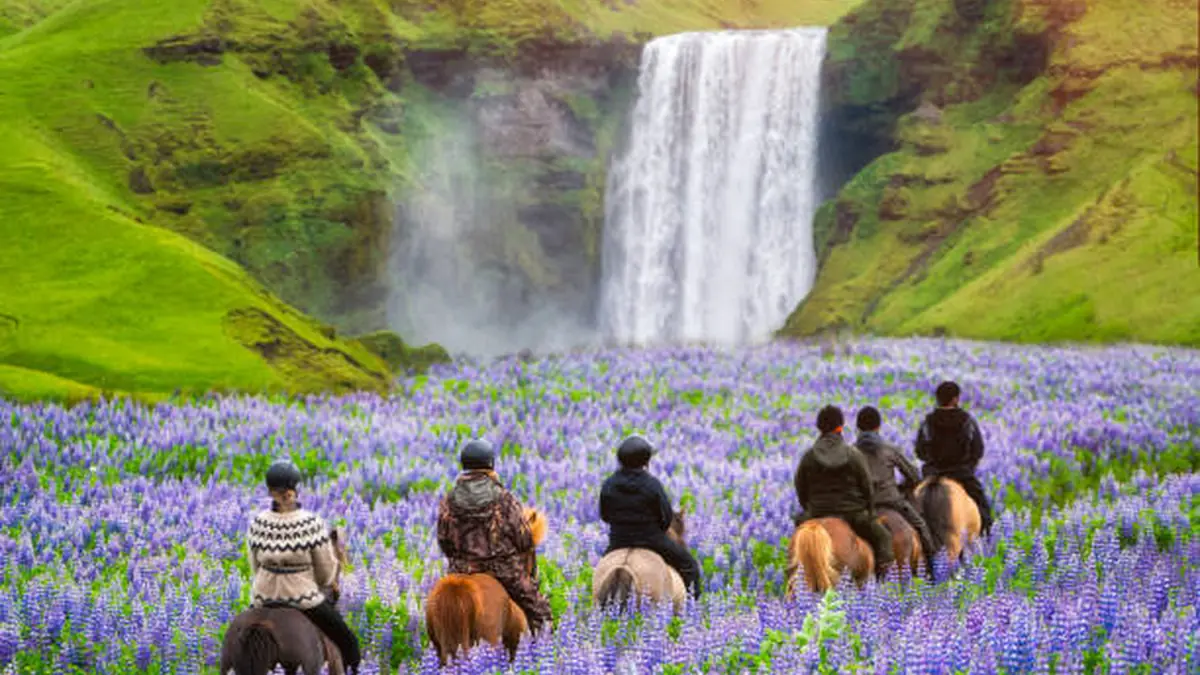
This is the waterfall-dense stretch of the trip. Seljalandsfoss (walk behind it) and the smaller, less-visited Gljúfrabúi are the first stops — go early if you can, since both draw crowds by mid-morning. Continue to Skógafoss, then push on to Vík, a small coastal town that makes a convenient overnight base near Reynisfjara black sand beach and the Dyrhólaey nature reserve. Dyrhólaey has its own black sand beach, sometimes called “The Endless Black Beach,” and marks the southernmost point of mainland Iceland — visit in summer and you may spot puffins nesting on the cliffs.
Day 3 – Jökulsárlón & Diamond Beach
From Vík, the drive toward Höfn takes you past the dramatic Fjaðrárgljúfur Canyon and a hike to Svartifoss waterfall before ending at Diamond Beach and the Jökulsárlón Glacier Lagoon. This is the day to book an optional add-on if your budget allows — a boat tour on the lagoon or a guided ice cave visit, depending on the season. Overnight near Höfn.
Day 4 – East Fjords to Egilsstaðir
The East Fjords are the quietest stretch of the Ring Road and the one most itineraries rush. Slow down here if you can; the fjord-side driving is dramatic and largely untouched by tour buses. Detour to Seyðisfjörður, a small fjord town known for its rainbow-painted street and wooden churches, before continuing to Egilsstaðir for the night. Studlagil Canyon, with its striking basalt column walls, is a worthwhile short detour if you have an extra hour.
Day 5 – Mývatn, Goðafoss & Akureyri
Cross the interior toward Lake Mývatn, a geothermal area with lava fields, pseudo-craters, and the Mývatn Nature Baths — a quieter, cheaper alternative to the Blue Lagoon. Stop at Goðafoss, one of Iceland’s most photogenic waterfalls and easily accessible right off the main road. From here you’ll continue on toward Akureyri, Iceland’s second-largest city, either overnighting there or pushing further to Laugarbakki to cut down tomorrow’s drive.
Day 6 – Húsavík Whales & Back to the West
Start the morning with a whale-watching tour in Húsavík, widely considered the whale-watching capital of Iceland, where it’s realistic to see several species including humpbacks up close. In the afternoon, work your way back west along the Ring Road, with a stop at either the Vatnsnes peninsula (look for the Hvítserkur sea stack) or the Grábrók crater and Kolugljúfur canyon, depending on your route. Overnight in Borgarnes.
Day 7 – Reykjavík, Blue Lagoon & Departure
Spend the morning back in Reykjavík doing the city sightseeing you skipped on Day 1 — Hallgrímskirkja, the harbour, and the Laugavegur shopping street can be covered on foot in two to three hours. If you haven’t done a geothermal lagoon yet, fit in the Blue Lagoon or Sky Lagoon before your flight, but build in generous buffer time — rental car return queues can run long in summer.
Quick Takeaway: This route covers the Golden Circle, South Coast, Jökulsárlón, East Fjords, Mývatn, Akureyri, and Húsavík in seven days. It intentionally skips Snæfellsnes and the Westfjords — both are better done as an eighth or ninth day, or on a separate trip.
Iceland Itinerary 7 Days: What It Actually Costs in 2026
Iceland isn’t a budget destination, and pretending otherwise just leads to sticker shock at the rental counter. Here’s a realistic breakdown for two people traveling together in 2026.
| Expense | Typical Range (per trip, 2 people, 7 days) |
|---|---|
| 2WD rental car + basic insurance | $700–$1,120 (at $100–$160/day) |
| 4×4 rental (if adding gravel/F-roads) | $1,400–$2,100 (at $200–$300/day) |
| 2026 per-kilometre road tax | roughly $75–$105 for the full loop |
| Accommodation (mid-range, 7 nights) | $1,400–$2,800 |
| Iceland lodging tax (new for 2026) | ~$5.80/room/night, roughly $40 over a week |
| Food (groceries + some restaurant meals) | $350–$600 per person |
| Fuel | $150–$250, depending on vehicle |
| Activities (ice cave, whale watching, lagoon) | $150–$400 per person |
A few 2026-specific things worth knowing before you budget:
The road tax changed. Iceland’s kilometre road tax took effect January 1, 2026, charging standard passenger vehicles 6.95 ISK per kilometre driven, replacing the old fuel-tax system. On a Ring Road trip of roughly 1,330 km, that tax alone adds approximately $75–$105 to your total before any admin fees. Most rental companies now convert this into a flat daily rate of around 1,390 ISK (about $10) per day, which makes budgeting simpler than paying per kilometre at drop-off. Fuel got cheaper to offset it — petrol prices dropped by roughly 90–95 ISK per litre in early January 2026 once the old fuel duties were removed.
Lodging costs more than the sticker price. Iceland reinstated and then raised its accommodation tax, now around 800 ISK (about $5.80) per room per night at hotels and guesthouses, plus an 11% VAT on lodging services — and this tax isn’t always shown upfront on booking platforms.
Watch out for August 2026. A total solar eclipse crosses western Iceland, the Westfjords, Snæfellsnes, and Reykjanes on August 12, 2026 — the first visible in Iceland since 1954 — and accommodation along the eclipse path has been selling out for over a year, with knock-on price and availability effects across the whole country that month. If your trip isn’t built around the eclipse, it’s worth avoiding August 2026 entirely and aiming for May–July or September–October instead, when pricing and availability are both better.
Parking isn’t always free. Many of Iceland’s most popular natural attractions now charge for parking, typically 750–1,500 ISK, and few have physical payment booths — download the Parka and Checkit.is apps before your first stop so you’re not caught without a way to pay.
Self-Drive or Guided Tour? Which Fits Your Trip
| Self-Drive | Guided Tour | |
|---|---|---|
| Flexibility | Full control over pace and stops | Fixed schedule, less spontaneity |
| Cost | Usually cheaper for 2+ people | Higher per person, but no driving stress |
| Logistics | You book car, hotels, route | Operators like Nordic Visitor or Guide to Iceland handle the car, accommodation, and suggested itinerary — you just show up and drive, or don’t drive at all on a fully guided trip |
| Best for | Confident drivers, couples, small groups wanting independence | First-timers nervous about winter roads, solo travelers, those who’d rather not navigate |
A self-drive package is a useful middle ground if you want independence without doing all the planning yourself — you still drive, but someone else has pre-booked the route and hotels.
Best Time to Go (and Why Winter Changes the Plan)
Summer (June–August) gives you the longest daylight, the most reliable roads, and full access to the entire Ring Road — but also the biggest crowds and highest prices. Shoulder season (May, September) trims the crowds while keeping most roads open.
Winter is a different itinerary entirely, and it’s worth being upfront about that. One traveler who researched a winter Ring Road attempt ultimately decided their limited time and daylight hours were best spent focused on the South Coast, where the road stays well maintained even in winter, rather than attempting the full loop. If Northern Lights season is your priority, consider a South Coast-focused week instead of the full circle, or add a couple of extra days to your winter trip as a buffer against weather delays.
What This Itinerary Skips — and What to Add If You Have More Time
Seven days forces trade-offs. Here’s what gets cut, and where to add it back if you have flexibility:
- Snæfellsnes Peninsula – if you have eight or nine days, this is the first addition worth making, slotted in between Borgarnes and Reykjavík near the end of the loop.
- Westfjords – a multi-day detour on its own; skip entirely on a 7-day trip unless you’re specifically chasing the 2026 eclipse path.
- Þórsmörk and F-road detours – only accessible with a proper 4×4, and only worth it if you have a spare half-day and the right vehicle.
Booking, Packing & Practical Tips
Book your car, every night’s accommodation, and any specific activities (Blue Lagoon, ice cave, whale watching) well in advance — summer crowds are noticeable and some regions only have one accommodation option, so those rooms sell out early.
Pack for four seasons in one day, regardless of the calendar month. Bring warm, windproof layers even in summer — the windchill can be brutal — plus hiking boots for trails and a swimsuit for the geothermal pools. A rain jacket earns its keep at almost every waterfall stop.
For more practical travel planning tips, check out our collection of travel guides.
FAQ Section
Is 7 days enough to drive Iceland’s Ring Road?
Yes, but it’s the minimum comfortable timeframe. Most drivers cover 3–5 hours per day and still feel rushed on at least one leg. If you can add a day, do — the East Fjords and Snæfellsnes both benefit from extra time.
Should I drive the Ring Road clockwise or counterclockwise?
Most itineraries go counterclockwise from Reykjavík, front-loading the South Coast and Jökulsárlón early in the trip. Clockwise works just as well — simply read the itinerary in reverse.
Do I need a 4×4 to drive the Ring Road in Iceland?
No, a standard 2WD car handles the paved Ring Road fine in summer. You only need a 4×4 for gravel detours, F-roads, or winter driving in the north and east.
How much does a 7-day Iceland trip cost in 2026?
Budget roughly $150–$250 per person per day, covering car rental, the new per-kilometre road tax, fuel, mid-range accommodation plus the lodging tax, food, and a couple of paid activities.
Is it better to self-drive or take a guided tour in Iceland?
Self-driving is usually cheaper and more flexible for two or more people comfortable behind the wheel. A guided or self-drive package suits first-timers, solo travelers, or anyone nervous about winter roads.
Can you do the full Ring Road in winter in 7 days?
It’s possible but riskier — daylight is short and weather can close roads without warning. Many experienced drivers recommend a South Coast-focused winter itinerary instead of attempting the whole loop.
What does Iceland’s new 2026 road tax mean for rental cars?
Since January 1, 2026, Iceland charges a per-kilometre road usage tax of 6.95 ISK/km, usually billed by rental companies as a flat daily fee around 1,390 ISK. Fuel prices dropped to help offset the change.
What should I skip on a 7-day Iceland itinerary?
The Snæfellsnes Peninsula and the Westfjords are the two biggest cuts on a 7-day loop. Add Snæfellsnes first if you gain an extra day or two.